![AAON knowledge base logo 2023.png]](https://www.aaon.com/hs-fs/hubfs/AAON%20knowledge%20base%20logo%202023.png?height=40&name=AAON%20knowledge%20base%20logo%202023.png)
A water chiller is a centralized refrigeration system used in large commercial or industrial applications to remove heat from water through the refrigeration cycle. That chilled water is then pumped throughout a building or facility to cool the air being delivered to the occupied spaces or pull heat away from industrial machinery. For engineers, facility managers, HVAC professionals, and other decision-makers evaluating cooling systems, understanding how water chillers work is key to choosing the right scalable solution for reliable and cost-effective temperature control. This article explains how water chillers operate, the main chiller types, the efficiency metrics used to compare them, common commercial applications, and how they can work with AAON air handling units.
What Is a Water Chiller? (Definition & Overview)
All chillers use the refrigeration cycle to remove heat from the water. A chiller system also contains pumps in the water loop that are used to pump water into and out of the chiller.
Evaporator -> Compressor -> Condenser -> Expansion Valve -> Repeat
Evaporator - Absorbs heat from the warm water returning from the building or industrial process. This causes the liquid refrigerant to evaporate into a gas, which is then sent to the compressor stage.
Compressors- (or Thermal Absorption System)- Most chillers will use a mechanical compressor to increase pressure and raise the temperature of the refrigerant vapor. However, some chillers use a thermal absorption chemical system instead of a mechanical compressor.
Condenser – The condenser is where heat is removed from the refrigerant. This causes the vapor to condense back into a liquid, which is then sent to the expansion valve.
Expansion Valve – Also known as a metering device, the expansion valve drops the pressure and temperature of the liquid refrigerant before sending it back to the evaporator to begin the refrigeration cycle again.
Pumps – Water pumps, typically centrifugal water pumps, are used in the chiller system loop to set the incoming and outgoing water flow. The pumps are integral to ensuring the water flows properly through the water loop of the chiller. If pumps are sized incorrectly, the pressure from the chiller may not be enough to push the water to the building.
The Chilled Water Loop — How Heat Is Distributed Through a Building
Once the water is chilled, where does it go? The cold water is sent through a chilled water distribution loop in the building, where it is delivered to an air handling unit or a fan coil unit, which uses it to cool the air from a space or remove heat from machinery.
Chilled water air handling units (AHUs) are air handlers designed to work with chiller systems. These units contain chilled water coils through which cold water from the chiller circulates. A fan inside the unit draws in warm return air from the building and blows it across the chilled water coils, cooling the air before it is returned to the occupied spaces. These units typically include air filters and often a modulating water valve that adjusts the amount of chilled water enters the coil based on the cooling demand of the spaces being served. Air handling units in chiller systems are used to condition entire floors, multiple zones, or an entire building at once–moving large volumes of air through extensive ductwork.
AAON offers chilled water air handling units, that could be utilized with a chiller building system design.
Fan coil units (FCUs) are individual, smaller units installed throughout a building that allow occupants to easily control the temperature of their room. These are often one per room, (or occupied space) typically located in the ceiling, on the wall, or at the window. They contain a cooling coil through which cold water from the chiller flows. A small fan draws warm air from the room and blows it across the coil, where the chilled water absorbs the heat. The cooled air is then discharged back into the space.
However, since FCUs recirculate indoor air, there is a lack of fresh outdoor air introduced into the space that would be received from a central air handling unit with outdoor capability. Filtration could also be limited in fan coil designs.
In summary, a chiller operates as a two-loop system. The first loop is the refrigeration circuit inside the chiller itself, which cools the water. The second loop distributes that chilled water through the building, where air handling units or fan coil units use it to cool the occupied spaces.
Types of Water Chillers — Choosing the Right System
Chillers are generally classified by two primary factors:
- How the condenser rejects heat – for example, through an air-cooled or water-cooled process.
- Type of compressor used – for example, does the chiller use a screw compressor or a centrifugal compressor?
Air-Cooled vs. Water-Cooled Chillers
Air-Cooled Chillers – These chillers are located outdoors, are fully self-contained, and do not require a cooling tower. They use ambient air to reject heat through the condenser coils. Air-cooled chillers are most suitable for buildings where water availability or space for a cooling tower is limited.
Water-Cooled Chillers – These chillers are generally considered more efficient than air-cooled chillers. They require a cooling tower, as the condenser uses a secondary water circuit to reject heat.
Centrifugal Chillers
Centrifugal compressors use velocity to raise refrigerant pressure rather than mechanically squeezing it, relying on centrifugal force imparted by a high-speed impeller.
Centrifugal compressors are most efficient at, or near, full load.
Screw Chillers
Screw compressors use two helical screws meshed, where one rotor drives the other. As the rotors rotate, refrigerant is carried from the suction side to the discharge side, while the trapped gas volume is continuously reduced or compressed.
Screw compressors provide a higher efficiency at full-load operation.
Scroll Chillers
Scroll compressors use two interlocking spiral scrolls to compress refrigerant. One scroll orbits around a fixed scroll continuously reducing the size of the refrigerant pockets and raising pressure.
Scroll compressors are valued for their efficiency, lower noise levels, and reliability relative to reciprocating designs.
Absorption Chillers
Absorption chillers operate without a compressor motor or the standard vapor-compression refrigeration cycle. Instead, they use a thermally driven cycle.
Water is used as the refrigerant: it is sprayed inside a sealed, low-pressure vessel where, in the absence of air, it boils and evaporates at a very low temperature. This evaporation absorbs heat from the chilled water loop, cooling the pipes connected to the system. The resulting water vapor is then absorbed by a salt solution (lithium bromide (LiBr)), which acts as the absorbent, soaking up the vapor until it is saturated. The diluted salt mixture is pumped to an external heat exchanger, where a heat source (such as waste steam, exhaust gas, or hot water from a boiler) boils the water vapor from the salt. The water vapor is then condensed back into liquid and returned to the evaporator, while the salt solution is returned, completing the cycle.
Water Chiller Efficiency — What the Numbers Mean
Chiller efficiency is the largest driver of long-term operating cost in a chilled water system. Understanding efficiency metrics can help a person compare different products, and maintaining consistent water temperatures helps improve performance.
COP, EER, and kW/ton — Explained
COP (Coefficient of Performance): The ratio of cooling output to energy input. In a chiller, a higher COP means more heat is removed per unit of electricity consumed. (In a heat pump, COP instead measures the ratio of heating output to energy input.)
A higher COP = more efficient.
EER/EER2 (Energy Efficiency Ratio): Cooling output in Btu/h divided by electrical input in watts. EER is more commonly used for air-cooled equipment; water-cooled chillers are more often rated in kW/ton or COP.
kW/ton: Measures the electrical power consumed per ton of cooling capacity. A lower value indicates greater efficiency — less electricity is required to produce one ton of cooling.
Lower kW/ton = more efficient.
IPLV and Part-Load Efficiency — Why It Matters More Than Full-Load Ratings
IPLV (Integrated Part-Load Value): weighted average efficiency across 25%, 50%, 75%, and 100% load. Commercial chillers run at partial load 80–90% of the time.
A chiller with a higher full-load rating but poor part-load efficiency will cost more to operate majority of the time.
Commercial Water Chiller Applications
Water chillers are suited for any application that requires centralized, scalable cooling.
Commercial Buildings — Offices, Hotels, Hospitals, Schools
Large multi-story buildings generate substantial heat loads, where chillers are commonly used. Chilled water systems allow a single chiller plant to serve dozens of air handlers and fan coil units.
Industrial and Manufacturing Applications
Chillers are used for process cooling in applications such as injection molding, laser cutting, waterjet cutting, welding, food and beverage processing, and data centers requiring precision temperature control. Chillers also protect heat-sensitive laboratory equipment, MRI machines, and CT scanners in medical and pharmaceutical applications to prevent system shutdowns.
These processes generate significant heat loads that must be controlled to protect equipment and maintain operating conditions. Chiller systems continuously pump chilled fluid to the machinery, absorb the heat generated, and carry it away to keep equipment running safely.
Special Applications and Chillers
Some chillers are unique to a specific application. An aquarium chiller is used to ensure precise temperature control for aquatic life. Some animals require very specific temperatures for their health. Although not used on a large commercial scale, smaller chillers can be used for cold therapy for hospitals and physical therapy institutions. These chillers provide the cold water to devices for helping patients through recovery. Chillers can also be used to supply controlled water temperatures for grow rooms, ensuring that plants are receiving the correct amount of temperature controlled water while still gaining the nutrients needed from the sun light.
AAON Air Handling Units
AAON offers air handling units that can be configured with chilled water coils, allowing them to integrate seamlessly into an application that utilizes a water loop in the building with water supplied by a chiller system.
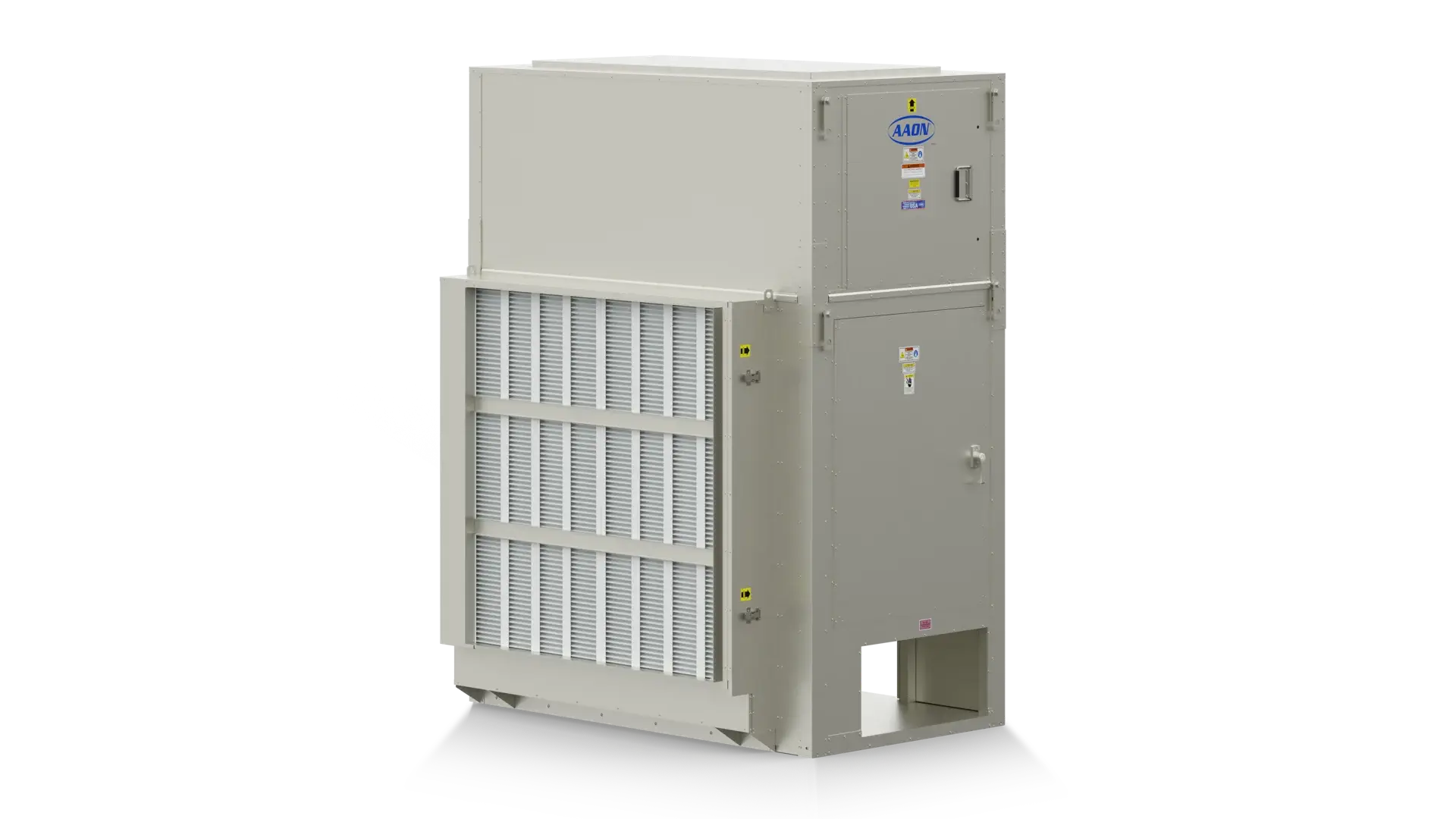
Engineered for Durability and Serviceability
AAON air handling units are engineered for long-term durability, featuring double-wall closed-cell polyurethane foam injected insulation and G90 galvanized steel walls, providing an insulation R-value of 8 or 16. Units are also designed for easy serviceability, with features such as color-coded wiring diagrams and access doors with handles to reduce maintenance downtime.
Peak Performance Features
AAON air handling units are available with advanced supply fan options, including VFD-controlled direct-drive backward-curved plenum fans or permanent magnet motor technology with an international efficiency rating exceeding IE5, available in the H3, V3, and RZ models.
All rooftop models come standard with paint rated to 2,500 hours of salt-spray corrosion resistance.
AAON units offer control flexibility, allowing customers to choose between factory-provided controls or a third-party control system.
Ready to spec an AAON air handling unit for your next project? Contact your AAON rep today to get started. They'll walk you through unit configurations, lead times, and pricing details so you know what to expect from quote to installation.
Frequently Asked Questions About Water Chillers
What is a water chiller?
A water chiller is a refrigeration system that removes heat from water using the refrigeration cycle. The chilled water is then circulated through pipes to air handlers, fan coil units, rooftop units, and other cooling equipment throughout a building or facility. A chiller provides centralized, scalable cooling.
How does a water chiller work?
A water chiller operates through a continuous four-step refrigeration cycle:
- Evaporator - Refrigerant absorbs heat from the building's return chilled water inside the evaporator, cooling the water down to the desired supply temperature.
- Compressor ( or Thermal Absorption System )— The compressor pressurizes the refrigerant vapor, raising its temperature and pressure.
- Condenser — The hot refrigerant releases its heat to the outdoors via the condenser — either through ambient air (air-cooled) or a cooling tower water loop (water-cooled).
- Expansion — An expansion valve drops the refrigerant's pressure and temperature, and the cycle repeats.
The chiller also contains pumps for circulating the water through the water loop of the chiller. The pumps help to bring warm water from the building then return cool water back to the building to be used in the equipment used for cooling a space.
What is the difference between an air-cooled and a water-cooled chiller?
The key difference is how each system rejects heat from the refrigerant:
- Air-cooled chillers use fans to blow ambient air across condenser coils, rejecting heat directly to the atmosphere. No cooling tower is required. They are self-contained, easier to install, and better suited for mid-size commercial buildings where water supply or tower space is limited.
- Water-cooled chillers use a condenser water loop connected to an external cooling tower to reject heat. Because water has a higher heat capacity than air, water-cooled systems more energy-efficient, but they require more infrastructure, water treatment, and dedicated tower space.
What are the main types of commercial water chillers?
Commercial chillers are classified by compressor technology:
|
Chiller Type |
Compressor |
|
Scroll |
Scroll compressor |
|
Screw |
Helical rotary screw |
|
Centrifugal |
Centrifugal impeller |
|
Absorption |
No compressor (heat-driven) |
Variable-capacity scroll compressors, which modulate from 10% to 100% capacity, are particularly well-suited for commercial buildings that spend the majority of their operating hours at partial load.
What is IPLV, and why does it matter more than full-load efficiency?
IPLV (Integrated Part-Load Value) is a weighted average efficiency rating measured across four operating points: 25%, 50%, 75%, and 100% of full capacity. This is similar to IEER (Integrated Energy Efficiency Ratio) that is used when rating large unitary package commercial rooftop equipment. Because commercial buildings operate at partial load roughly 80–90% of the time, IPLV is a far more accurate predictor of real-world energy costs than full-load ratings alone.
How efficient is a commercial water chiller?
Chiller efficiency is measured in kW/ton — lower is better.
COP (Coefficient of Performance) and EER (Energy Efficiency Ratio) are alternative metrics: a COP of 5.0 means the chiller delivers 5 units of cooling for every 1 unit of electrical energy consumed.
A higher COP = more efficient.
Look for chillers certified to AHRI 550/590. This is the industry standard test procedure for chilled water equipment.
How long does a commercial water chiller last?
A properly maintained commercial water chiller typically could have a service life of 20–25 years.
Key factors that influence longevity include:
- Water treatment quality — scale, corrosion, and biological growth are the leading causes of premature failure. Clean water ensures the chiller can operate for a longer period of time.
- Maintenance frequency — annual coil cleaning, refrigerant charge verification, and pump inspection
- Factory assembly quality — units that are run-tested before shipment arrive in proven working condition, reducing startup failures and early-life reliability issues
- Serviceability design — accessible control compartments, labeled wiring, and clear documentation reduce technician time and the risk of maintenance errors over the unit's life.
Can a water chiller be used for heating?
Yes, some commercial chillers include heat recovery capability, functioning as heat pump chillers. This system could also be known as a water to water heat pump. A heat pump chiller can be an effective solution in climates that are cooler for a majority of the year. During the cooling cycle, waste heat generated at the condenser is captured and redirected for space heating or domestic hot water rather than being rejected to the atmosphere.
Heat recovery chillers are increasingly specified in high-performance commercial buildings as part of electrification strategies, delivering both cooling and heating from a single refrigeration system.
What maintenance does a commercial water chiller require?
A standard commercial chiller maintenance program might include:
Quarterly:
- Inspect and clean condenser coils
- Check water quality (pH, glycol concentration, corrosion inhibitor levels)
- Clear cooling tower basin of debris (water-cooled systems)
Annually:
- Verify refrigerant charge
- Inspect expansion valves, compressor operation, and electrical connections
- Review performance logs
Ongoing:
- Maintain closed chilled water loop
- Log entering and leaving water temperatures to detect efficiency degradation early
- Some units use filtration; operators should still service the filter at the recommended times
Proper maintenance of the systems ensures a chiller operates efficiently, which can save money from replacing parts or the equipment.