![AAON knowledge base logo 2023.png]](https://www.aaon.com/hs-fs/hubfs/AAON%20knowledge%20base%20logo%202023.png?height=40&name=AAON%20knowledge%20base%20logo%202023.png)
What Is an AC (Air Conditioner) Compressor?
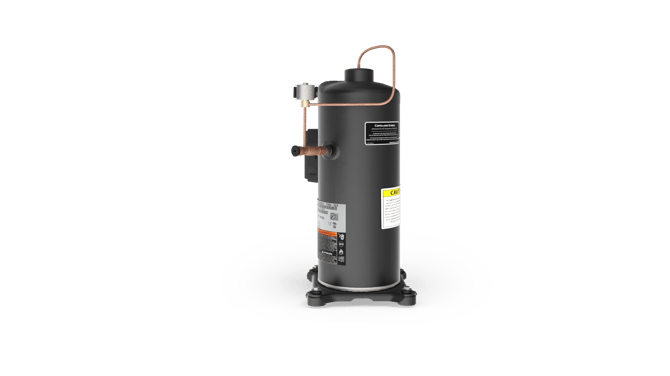
A compressor plays a vital role in the refrigerant cycle of an HVAC system. Often described as the heart of the system, it increases refrigerant pressure so it can circulate through the loop connecting the four main components of the cycle. When refrigerant leaves the compressor, it is a high‑pressure, high‑temperature vapor, ready to transfer heat in the condenser.
In commercial applications, compressor selection carries more responsibility compared to residential settings. An efficient commercial compressor can save you up to thousands of dollars per year. Therefore, selecting the correct compressor for the application is a major design and operational decision.
The Role of the Compressor in the Refrigeration Cycle
The refrigeration cycle (also known as the vapor compression cycle) consists of four core primary components:
- Compressor - Compresses the refrigerant, increasing its pressure and temperature. The refrigerant leaves as a high-pressure, high-temperature vapor sent to the condenser.
- Condenser Coil - The condenser is a coil through which refrigerant flows, surrounded by outdoor air (OA) that passes over the coil. As the outdoor air flows over the coil, heat transfers from the refrigerant to the air, causing the refrigerant to condense from a gas into a cooler liquid state.
- Expansion Valve - Drops the liquid refrigerant's pressure and temperature before it enters the evaporator.
- Evaporator Coil - The cold, low-pressure refrigerant absorbs heat from the air passing over the coil, providing cooling and dehumidification to the indoor air stream. As the refrigerant warms, it reverts to a vapor and returns to the compressor to begin the cycle again.
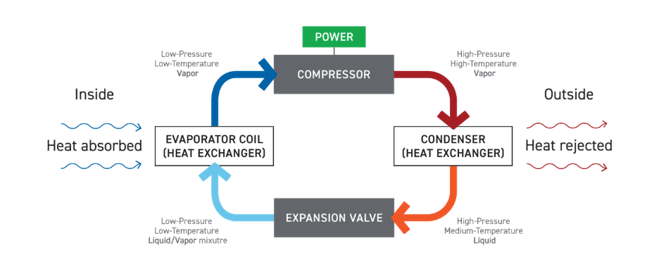
In a typical residential split system, the condenser sits outside the home while the evaporator is indoors. In commercial applications, all four components are often integrated into a single packaged rooftop unit (RTU), though split configurations are also common.
Where Is the AC Compressor Located in a Commercial System?
Compressor location depends on the system type. In a split system, the compressor is housed within the outdoor condensing unit. In a packaged rooftop unit, all system components including the compressor, condenser, expansion valve, and evaporator are all contained within a single rooftop cabinet. AAON offers both split system and packaged rooftop configurations to match a wide range of commercial building requirements.
Types of AC Compressors Used in Commercial HVAC Systems
Commercial HVAC systems use several compressor technologies, each with distinct operating principles and efficiency.
Scroll Compressors
Scroll compressors use two interlocking spiral scrolls to compress refrigerant. One scroll remains fixed while the other orbits around it, continuously reducing the size of the refrigerant pockets and raising pressure. This provides continuous compression with fewer moving parts than alternative designs.
Scroll compressors have become the dominant technology in commercial HVAC units, valued for their efficiency, lower noise levels, and reliability relative to reciprocating designs. They are available in several configurations including on/off, two-stage, variable capacity (or digital), and variable speed to suit different capacity and efficiency requirements.
Reciprocating (Piston) Compressors
Reciprocating compressors are the oldest design in HVAC. A crankshaft-driven piston moves back and forth within a cylinder, compressing the refrigerant gas. Suction and discharge valves open and close based on pressure differentials, drawing refrigerant in and pushing it out.
While reciprocating compressors generally carry a lower upfront cost than scrolls, they offer less efficiency. Once the standard commercial compressor type, they have largely given way to scroll compressors in modern commercial HVAC systems and are more commonly found in residential equipment today.
Screw Compressors
Screw compressors use two helical screws meshed, where one rotor drives the other. As the rotors rotate, refrigerant is carried from the suction side to the discharge side while the trapped gas volume is continuously reduced or compressed.
Screw compressors provide a higher efficiency at full-load operation and are commonly found in industrial HVAC systems and large commercial chillers. Their higher upfront cost is offset by lower long-term energy expenses in high-capacity applications.
Centrifugal Compressors
Unlike the positive-displacement designs above, centrifugal compressors are dynamic machines that use velocity rather than mechanical squeezing to raise refrigerant pressure. A high-speed impeller imparts kinetic energy to the low-pressure refrigerant gas using centrifugal force. That high-speed refrigerant gas is sent through a diffuser, which slows it down, converting its kinetic energy into high-pressure refrigerant gas directed to the condenser.
Centrifugal compressors are most efficient at, or near, full load and like screw compressors are typically used in large-scale applications such as chillers or large industrial HVAC systems.
Inverter / Variable-Speed Compressors
Variable-speed (inverter-driven) compressors represent the current leading standard in high-efficiency operation. A variable frequency drive (VFD), or inverter, modulates compressor motor speed in real time, allowing the unit to deliver precisely the amount of cooling demanded rather than cycling fully on or off.
Variable-speed technology can be applied to scroll, screw, or reciprocating compressor designs. Because commercial buildings spend most operating hours at partial cooling loads, variable-speed compressors deliver the greatest long-term energy savings in most commercial applications.
How Does an AC Compressor Work? Step-by-Step
The Refrigeration Cycle: From Low-Pressure to High-Pressure Gas
Refrigerant enters the compressor through the suction port as a low-pressure, low-temperature vapor. Before entering the compressor, this vapor is slightly superheated, meaning its temperature is a few degrees above its saturation (boiling) point. Superheat protects the compressor from liquid refrigerant entering the mechanism, which can cause severe damage.
The compressor applies mechanical energy to the refrigerant, dramatically raising both its pressure and temperature. Discharge gas exits at a high temperature and at a pressure high enough to allow heat rejection in the condenser. The ratio of discharge pressure to suction pressure is referred to as the compression ratio, and it has a direct effect on compressor efficiency and longevity.
From the compressor, the hot, high-pressure gas travels to the condenser coil where it rejects heat to the outdoor air (or water, in water-cooled systems). After heat rejection, the refrigerant leaves the condenser as a subcooled liquid, meaning it has been cooled a few degrees below its saturation temperature. Subcooling improves system efficiency by ensuring no flash gas reaches the expansion device. The expansion valve then drops the pressure and temperature sharply before the refrigerant enters the evaporator coil to absorb heat from the indoor air stream.
Single-Stage, Two-Stage, Variable-Speed, and Variable Capacity Compressors: What's the Difference
Single-Stage (On/Off): Also called on/off compressors, these operate at either 0% or 100% capacity with no intermediate setting. When the thermostat calls for cooling, the compressor runs at full capacity. When the temperature setpoint is reached, it shuts off entirely. Single-stage compressors achieve strong full-load efficiency ratings but cycle on and off repeatedly during mild weather, which reduces part-load efficiency and can lead to humidity control issues.
Two-Stage: Two-stage (or two-step) compressors can operate at either full capacity (100%) or a reduced stage, typically around 65%. This additional stage allows the system to better match output to demand during mild conditions, improving part-load efficiency and humidity control relative to a single-stage design. Two-stage compressors offer a meaningful efficiency improvement over on/off models at a lower price than variable-speed, making them a practical and often cost-optimal choice for many applications.
Variable-Speed: Variable-speed compressors use a variable frequency drive (VFD) to continuously adjust the motor speed. By matching output precisely to the real-time cooling load, they minimize energy waste and deliver the most consistent supply air temperature and humidity levels. For commercial buildings where cooling demand shifts constantly throughout the day, variable-speed and digital compressors deliver the best combination of comfort and operating cost.
Variable Capacity (Digital Scroll): Digital scroll compressors achieve variable capacity through modulating capacity by rapidly loading and unloading the scroll mechanism in a controlled cycle, rather than adjusting motor speed like variable speed compressors. This allows the compressor to effectively deliver anywhere from 10% to its full capacity without the need for a variable frequency drive. The result is similar to variable-speed performance in terms of part-load efficiency and temperature and humidity control.
Signs Your Commercial AC Compressor Is Failing
Early identification of compressor problems or a faulty compressor is critical in commercial settings. A complete compressor failure can shut down cooling across an entire building and, if left unaddressed, can cause cascading damage to other system components.
Warm Air or Inconsistent Temperatures Across Zones
Warm supply air or uneven temperatures across building zones could indicate that the compressor is not properly pressurizing and circulating the refrigerant. This can result from a compressor that is overworked, losing compression capacity, or beginning to fail. If certain zones are consistently warmer than others despite balanced airflow, the compressor should be among the first components inspected.
Strange Noises — Grinding, Banging, Squealing, or Rattling
Any abnormal noise coming from the compressor or the unit housing it should be treated as a warning sign, as it could indicate a mechanical failure (like damaged internal parts). Unusual noise alone does not confirm compressor failure, but it warrants a prompt service call before the condition worsens.
Frequent Circuit Breaker Trips or Electrical Faults
A compressor that repeatedly trips the circuit breaker is drawing more amperage than the electrical circuit is rated to handle. This can be caused by a variety of issues including the compressor overworking due to low refrigerant charge, dirty condenser coils forcing the system to work harder, a short circuit within the compressor motor windings, or early-stage mechanical failure. Electrical faults should never be ignored or simply reset without investigating the cause.
Refrigerant Leaks or Visible Frost on Lines
Frost accumulating on refrigerant lines or the evaporator coil typically could indicate low refrigerant pressure and may be caused by a refrigerant leak. When the refrigerant charge is insufficient, the compressor must work harder to maintain system pressure, generating excess heat that can degrade the compressor over time. If a refrigerant leak is suspected, a licensed technician should locate and repair the leak, as simply adding refrigerant without addressing the source is a temporary fix that risks further damage.
Sudden Spike in Energy Consumption
An unexplained increase in energy consumption can indicate a compressor that is struggling to meet demand. As compressors age or develop mechanical problems, they draw more power to produce the same cooling output. Monitoring utility bills or building automation system data for unusual spikes in HVAC energy use is a straightforward way to catch early-stage compressor deterioration before it leads to complete failure.
Short Cycling — Compressor Turning On and Off Repeatedly
Short cycling is when the compressor repeatedly starts and stops without completing a full run cycle. Frequent short cycling accelerates component wear and shortens the compressor life. Common causes include clogged air filters reducing airflow, low refrigerant charge, or a unit that has been oversized for the space it serves. Oversized equipment cools the space too quickly and shuts off before the system can adequately dehumidify the air, leaving occupants in a space that feels cold but clammy. Short cycling should be diagnosed and corrected promptly to protect compressor longevity.
How Long Does an AC Compressor Last in a Commercial System?
Commercial HVAC compressors, when properly maintained, typically reach a service life of 15 to 20 years. This is longer than the 10- to 15-year average commonly cited for residential equipment, which operates under lighter duty cycles. Actual lifespan varies considerably based on operating conditions and maintenance practices.
Factors That Affect Commercial Compressor Lifespan
Several factors determine how long a compressor will remain in reliable service:
- Annual operating hours and load intensity: A compressor serving a 24/7 data center faces significantly more wear than one in an 8-hour office building, even if both are the same size.
- Refrigerant charge accuracy: Both overcharge and undercharge create abnormal operating pressures that stress the compressor motor and mechanical components over time.
- Coil cleanliness: Dirty condenser coils raise discharge pressure, forcing the compressor to work harder and run hotter. Dirty evaporator coils restrict airflow and can cause suction pressure to drop below safe operating limits.
- Electrical supply quality: Voltage fluctuations, phase imbalances, and poor power quality cause repeated electrical stress that degrades compressor motor insulation and can lead to premature failure.
- Operating environment: Coastal locations expose equipment to salt air corrosion. Industrial environments may introduce airborne chemicals or particulates. Extreme ambient temperatures push compressors toward the edges of their rated operating envelopes.
- Equipment quality: Higher-quality compressors last longer under comparable conditions.
Preventive Maintenance That Extends Compressor Life
Consistent preventive maintenance is the one of the most effective tools in extending the life of a compressor.
A common comprehensive maintenance checklist typically includes:
- Refrigerant charge verification
- Coil cleaning
- Filter replacement to protect airflow
- Electrical inspection
- Oil separator service on screw compressors to maintain lubrication quality
- Vibration analysis to detect early bearing wear
Commercial AC Compressor Replacement: Repair vs. Replace
When a commercial compressor fails, the decision to replace only the compressor or invest in a full system could depend on the age of the system, the refrigerant it uses, the condition of other components, and the total cost.
When to Replace Only the Compressor
Replacing the compressor alone can be the more cost-effective path when the following criteria apply:
- The system is less than 10 years old and otherwise in good operating condition
- The compressor is still within the manufacturer warranty period
- The failure was caused by a specific, correctable issue such as an electrical fault or refrigerant overcharge, rather than generalized wear across the system
- The unit uses a current-generation refrigerant (ideally compatible with A2L refrigerants to avoid another transition cost in the near term)
When to Replace the Entire Packaged Unit
A full unit replacement becomes the more prudent investment when the overall system has reached the end of its useful life or has too many points of failure.
Signs that it may be time to replace the unit:
- The system is 15 years old or older
- The unit uses an older refrigerant like R-22, which has been fully phased out and is only available at high cost from stockpiles, or R-410A, which is currently mid-transition under 2025 DOE regulations
- Multiple components are failing
- System efficiency has degraded well below current IEER standards, meaning operating costs are significantly higher than a modern replacement would produce
- Replacement qualifies for utility rebates or tax deductions that substantially offset the total installed cost
The A2L Refrigerant Transition and Its Impact on Compressor Decisions
The shift to A2L refrigerants is actively reshaping compressor selection for both new equipment and replacement decisions. HVAC equipment manufactured under current DOE regulations must use lower global warming potential (GWP) refrigerants, with the two primary A2L options in commercial HVAC being R-454B and R-32.
A2L refrigerants require compressors and system components specifically rated and tested for use with mildly flammable refrigerants.
HVAC units that were manufactured before the transition and remain in inventory may still be available for purchase with non-A2L refrigerants, as the regulatory changes apply to units manufactured after specified effective dates.
Because AAON builds equipment to order, all AAON systems currently being produced and sold are A2L refrigerant systems equipped with compressors designed and tested to run R-454B.
AC Compressor Efficiency — What Commercial Buildings Need to Know
The compressor is the driving factor of a system's efficiency ratings.
Variable-speed compressors produce higher part-load efficiency ratings, while single-stage on/off compressors tend to show stronger full-load efficiency numbers. Since most commercial buildings spend the vast majority of their operating hours at partial cooling load, part-load performance is typically the more meaningful benchmark.
SEER/SEER2 vs. IEER/IEER2 — Which Metric Actually Matters for Commercial Buildings
SEER2 (Seasonal Energy Efficiency Ratio 2): SEER2 applies primarily to residential and light commercial systems with cooling capacity below 65,000 Btu/h. It represents the total cooling output of the system over an entire cooling season divided by the total electrical energy input over that same period.
IEER2 (Integrated Energy Efficiency Ratio 2): IEER2 is the accepted efficiency standard for commercial HVAC equipment. IEER2 calculates an average efficiency across part-load operating conditions. IEER2 is the rating that reflects real-world operating costs for commercial HVAC equipment.
When evaluating commercial rooftop units, always compare IEER2 ratings rather than full-load EER2 alone. A unit with an impressive full-load number but poor part-load performance will consistently underperform its rating in actual operation.
Variable-Speed Compressors and Operating Cost Savings
Variable-speed and variable capacity (digital scroll) compressors both modulate their output to closely match real-time cooling demand. Variable-speed compressors accomplish this by adjusting motor speed through a VFD, while digital scroll compressors achieve modulation through rapid loading and unloading of the scroll mechanism. Both approaches reduce energy consumption during the partial-load conditions that represent the majority of a HVAC system's operation.
The table below illustrates how the four main compressor configurations compare across the metrics most relevant to commercial buildings. Actual energy savings depend on building load profile, climate zone, and equipment sizing.
|
Metric |
Single-Stage (On/Off) |
Two-Stage |
Variable-Speed |
Variable Capacity (Digital Scroll) |
|
Capacity Modulation |
0% or 100% |
~65% or 100% |
~20% to 100% continuously |
~10% to 100% |
|
Part-Load Efficiency |
Low — cycles fully off/on |
Moderate-to-High |
High — matches load precisely |
High — closely matches load demand |
|
Best Operating Condition |
Full-load cooling demand |
Part load conditions |
Variable or partial load (typical commercial) |
Variable or partial load (typical commercial) |
|
Approx. Annual Energy Cost |
Highest |
Moderate-to-Low |
Lowest |
Low |
|
Typical IEER2 Range |
Lower |
Mid-range |
Highest |
High |
|
Upfront Cost |
Lowest |
Moderate |
Highest |
Moderate-to-High |
|
Best Suited For |
Smaller, consistent loads |
Most commercial buildings |
Large buildings, strict comfort or energy goals |
Buildings seeking variable capacity without a VFD |
Over a 15-year service life, the cumulative energy savings from a variable-speed compressor or variable capacity compressor frequently exceed the initial cost premium compared to a single-stage or two-stage alternative, making total cost of ownership the more meaningful comparison than purchase price alone.
AAON Commercial AC Compressors — Built for Demanding Applications
AAON designs its equipment to handle a wide range of commercial applications and operating conditions. Across AAON's product lines, one can select from variable-speed, variable-capacity (digital scroll), and two-stage configurations to match the specific efficiency, capacity, and redundancy requirements of the building.
Compressor Technology Across AAON Product Lines
The table below summarizes the compressor configurations available across AAON's commercial product lines.
|
Product Line |
Compressor Options |
Notes |
|
Two-step scroll, digital scroll, variable speed, refrigerant-injection variable speed |
Refrigerant-injection option for low-ambient applications |
|
|
Variable speed, refrigerant-injection variable speed, 2-step scroll, and variable capacity (digital) |
Low-ambient capable |
|
|
Tandem variable speed + on/off; up to four variable speed + two tandem on/off; two variable speed scroll |
Tandem configurations for larger capacities |
|
|
R-454B DX cooling matched to R-454B condensing unit (e.g., CF Series condenser) |
Air handling units; paired with external condensing unit |
|
|
Two-step, variable capacity, on/off tandem, variable capacity + on/off tandem |
Condensing unit pairings for split systems |
|
|
SA: two-step and variable capacity; SB: variable capacity scroll |
Self-contained and indoor air handling units |
|
|
Two-step scroll, variable capacity tandem scroll, tandem variable capacity scroll |
Flexible configurations for varied load profiles |
AAON Aftermarket Parts and Compressor Support
AAON and its network of local representatives provide comprehensive support to keep equipment running at peak performance and minimize costly downtime. AAON parts distribution network stocks OEM replacement components, including compressor replacements.
AAON backs its compressors with a 5-year non-prorated warranty, providing meaningful protection and peace of mind on one of the most critical components in their HVAC system.
Frequently Asked Questions About AC Compressors
What is an AC compressor and what does it do?
An AC compressor is the mechanical core of any air conditioning system, often called the “heart” of the unit. Its primary job is to pressurize low-pressure refrigerant gas, raising its temperature and pressure so the refrigerant can carry heat out of a building. In commercial packaged rooftop units, the compressor is housed inside the rooftop cabinet, or in some configurations the compressor may be mounted externally beneath the condenser coil. the condenser and evaporator, creating a fully self-contained system. Without a functioning compressor, the refrigeration cycle stops entirely and no cooling is produced.
How does an AC compressor work?
The compressor drives the refrigeration cycle (also known as the vapor compression cycle) in a continuous loop:
- Low-pressure refrigerant gas enters the compressor through the suction port
- The compressor applies mechanical energy, dramatically increasing pressure and temperature
- Hot, high-pressure gas exits through the discharge port and travels to the condenser coil
- The condenser releases that heat to the outside air and the refrigerant becomes liquid
- The expansion valve drops the pressure, rapidly cooling the refrigerant
- The cold refrigerant passes through the evaporator coil, absorbing heat from indoor air
- The now-warmed, low-pressure gas returns to the compressor and the cycle repeats
In variable-speed commercial systems, the compressor modulates its output continuously to match the building's real-time cooling demand rather than cycling fully on or off.
What are the different types of AC compressors used in commercial HVAC?
The primary compressor types are used in commercial HVAC systems:
- Scroll compressors — Two interlocking spiral scrolls compress refrigerant continuously. Fewer moving parts, quieter operation, and excellent part-load efficiency make them the dominant choice in commercial rooftop units.
- Reciprocating (piston) compressors — A cylinder-and-piston design, the oldest and most widely understood type. Reliable and cost-effective for smaller systems, but more moving parts mean higher maintenance frequency.
- Screw compressors — Two meshing helical rotors provide high-capacity, continuous compression. Used in large commercial systems for applications such as large office buildings, hospitals, and data centers.
- Centrifugal compressors — Use a high-speed impeller to compress refrigerant dynamically. Designed for very large-scale applications like chillers and district cooling plants. Most efficient at full load.
- Inverter / variable-speed compressors — Variable-speed compressors modulate capacity matching output to actual load. Since commercial buildings operate at partial cooling load majority of the time, these deliver the greatest long-term energy savings.
What are the signs of a failing commercial AC compressor?
Early detection of compressor problems is critical in commercial settings - a full failure can shut down cooling across an entire building. Watch for these warning signs:
- Warm or inconsistent air from supply vents despite the system running
- Unusual noises — grinding, banging, squealing, or rattling from the rooftop unit
- Short cycling — the compressor turning on and off rapidly, never completing a full run cycle
- Frequent circuit breaker trips or unexplained electrical faults near the outdoor unit
- Rising energy bills without a change in occupancy or setpoints
- Refrigerant leaks or visible frost buildup on refrigerant lines
- Humidity issues — a space that feels cold but clammy often indicates a compressor not running long enough to dehumidify
If multiple symptoms appear together, contact a licensed commercial HVAC technician immediately. Continuing to operate a struggling compressor risks damaging the condenser, expansion valve, and other system components.
Can you run AC with a bad compressor?
No. A failed or failing compressor means the refrigeration cycle is broken — refrigerant cannot circulate, heat cannot be transferred, and the system cannot produce cool air regardless of whether the fans are running. Beyond the lack of cooling, operating a system with a damaged compressor can cause correlated failures in connected components, potentially turning a compressor replacement into a full system replacement. If compressor failure is suspected, shut the system down and schedule a professional inspection.
How long does a commercial AC compressor last?
With proper preventive maintenance, commercial HVAC compressors typically last 15–20 years — longer than the 10–15 year average commonly cited for residential units, which are built to lighter duty cycles. Actual lifespan depends heavily on:
- Total annual operating hours — a 24/7 data center vs. an 8-hour office building
- Refrigerant charge quality — both overcharge and undercharge accelerate wear
- Coil cleanliness — dirty coils force the compressor to work harder
- Electrical supply quality — voltage fluctuations cause significant compressor damage over time
- Operating environment — coastal salt air, industrial chemicals, and extreme heat all shorten service life
Annual professional maintenance is the single most effective way to protect compressor longevity.
When should I replace just the compressor vs. the whole packaged unit?
This is one of the most consequential decisions for a facility manager. A useful framework:
Replace only the compressor if:
- The system is less than 10 years old and otherwise in good condition
- The compressor is still within its manufacturer warranty period
- The failure was caused by a specific, correctable issue (electrical fault, refrigerant overcharge) rather than generalized wear
- The unit uses a current-generation refrigerant (not R-22, and ideally A2L-compatible)
Consider replacing the full packaged unit if:
- The system is 15 years old or older
- The unit uses R-22 (already phased out) or R-410A (mid-phase transition underway as of 2025)
- Multiple components are failing or efficiency has degraded well below current IEER standards
- Replacement qualifies for utility rebates, ENERGY STAR incentives, or IRA Section 179D tax deductions that significantly offset the total cost
- Repair cost exceeds 50% of the installed cost of a comparable new unit
What refrigerant does a commercial AC compressor use?
Refrigerant selection is undergoing significant industry change in 2025–2026. The current landscape:
- R-410A — The dominant commercial refrigerant for the past two decades. This was phased down under EPA AIM Act regulations, with new equipment production transitioning to lower-GWP alternatives.
- A2L refrigerants (R-32, R-454B, R-466A) — Next-generation low-GWP alternatives now entering commercial HVAC at scale. These require compressors and system components specifically rated for mildly flammable refrigerants.
- R-22 — Fully phased out. Any system still running R-22 is operating on stockpiled refrigerant at high cost and should be prioritized for replacement.
AAON's current product lines are engineered for next-generation refrigerant compatibility.
What does IEER/IEER2 mean and why does it matter for commercial compressors?
IEER/IEER2 (Integrated Energy Efficiency Ratio) is the efficiency metric that actually reflects commercial building operating conditions. IEER2 measures weighted average efficiency across a range of part-load conditions.
A compressor or system with a high full-load EER2 but poor part-load performance will consume more energy in real-world operation. When evaluating commercial rooftop units, always compare IEER2 ratings rather than full-load EER2.