![AAON knowledge base logo 2023.png]](https://www.aaon.com/hs-fs/hubfs/AAON%20knowledge%20base%20logo%202023.png?height=40&name=AAON%20knowledge%20base%20logo%202023.png)
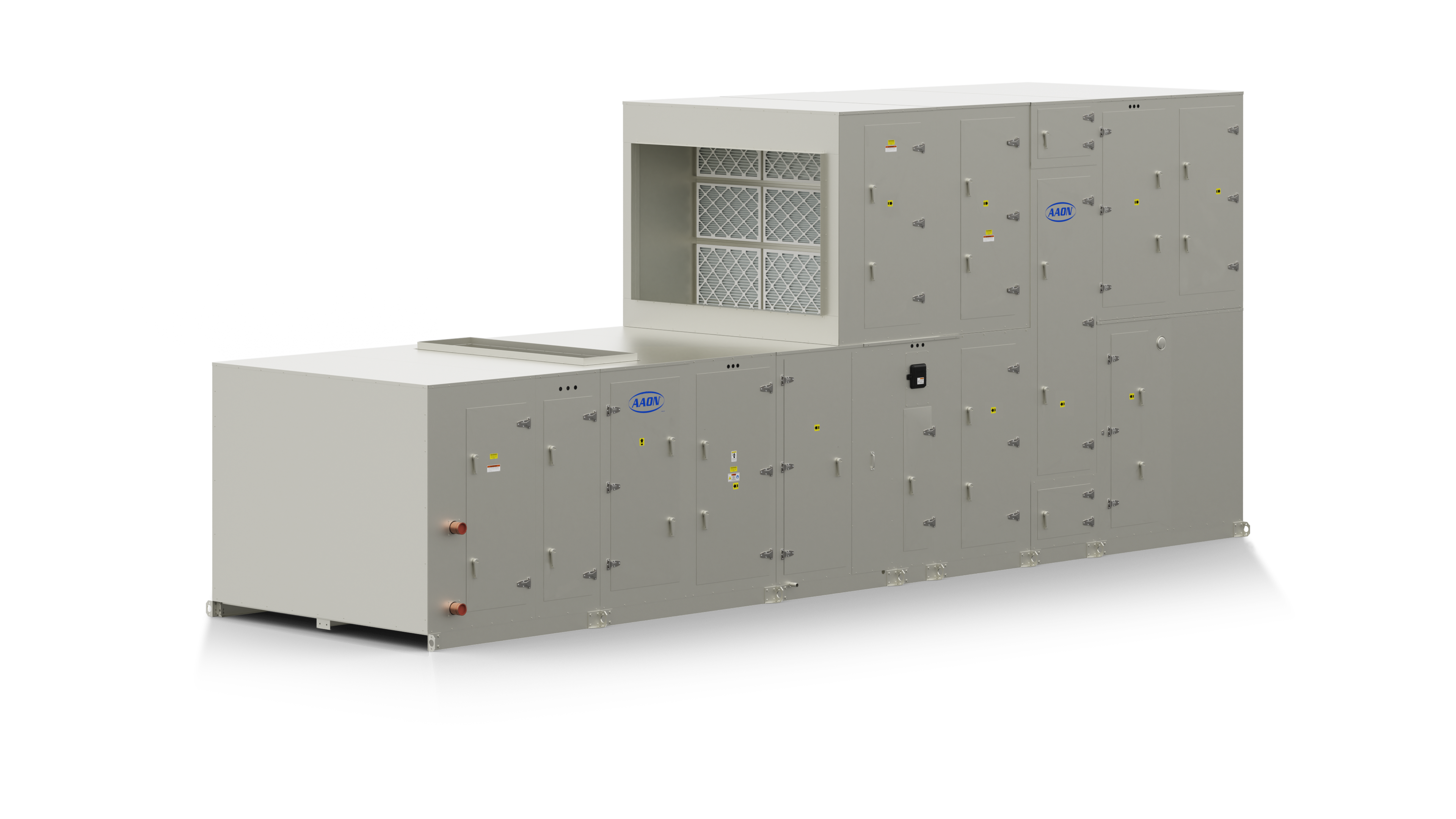
AAON M2 Series air handler unit is available with chilled water or direct expansion coils
What Is an Air Handler Unit? (Definition + How It Fits the HVAC System)
ASHRAE defines an air handling unit as “Assembly consisting of sections containing a fan or fans, and other necessary equipment to perform one or more of the following functions: air circulation, filtration, heating, cooling, heat recovery, humidifying, dehumidifying and mixing of air, and necessary control functions.”
An AHU is not one fixed piece of equipment, but rather a configurable system built around the building’s needs.
Air handling units are typically seen as one half of a split system, with the other half being the condensing unit. The air handler is the side that conditions the air and circulates it into the space. The condensing unit is where the compressor and condenser lives, rejecting the heat absorbed by the AHU to the outdoors. In a heat pump setup, that cycle reverses and the outdoor unit pulls in heat in rather than pushing it out. The AHU is then used to reject that heat into the space. An AHU will also often contain heating elements like a gas furnace or electric heat strips.
Air Conditioner vs. Air Handler Unit — What's the Difference?
“Air conditioner” usually refers to the cooling side of an HVAC system, and it is a loose term.
“Air handler” is more specific. It is a specific part of the system, that's responsible for conditioning the air and pushing it into the space.
Air Handler Unit vs. Fan Coil Unit — Are They the Same?
No. A fan coil unit (FCU) serves a single room or zone and includes a fan and a heating or cooling coil, usually supplied with hot or chilled water. It recirculates indoor air with limited filtration and has no dedicated outdoor air connection.
An air handling unit (AHU) is the larger, central system that can bring in and condition outdoor air. AHU's can be configured with filtration, energy recovery, humidity control, and multiple fan sections. Many buildings use both systems, with an AHU or DOAS (Dedicated Outdoor Air System) conditioning the ventilation air and FCU's handling individual zones.
How a Commercial Air Handler Unit Works
Inside the unit, incoming air is mixed, filtered, and conditioned to meet the space requirements, including heating, cooling, and dehumidification when needed, before being distributed through the duct system. The air-path depends entirely on the system’s configuration.
What’s Inside an Air Handling Unit?
- Coils – The main cooling coil is the evaporator coil in a DX unit, or the chilled water coil in a hydronic unit. In a heat pump, that same indoor coil acts as an evaporator during cooling and a condenser during heating. Other coils could include preheat coils, reheat coils, and hot water or steam heating coils.
- Economizers – A damper system that brings outdoor air into the unit when outdoor conditions are cool or dry enough to offset mechanical cooling and save energy.
- Energy Recovery Devices – Wheels or fixed plate exchangers that transfer heat, and sometimes moisture, between the exhaust airstream and the incoming outdoor airstream. See how energy recovery works here.
- Furnace or Electric Heater – In a split system, heating is usually built into the air handler, usually a gas heat exchanger, electric heat strips, or hot water and steam coils tied into a boiler system.
- Humidity Control – Both dehumidification and humidification happen inside the air handling unit.
- Fans – Supply fans, return fans, and exhaust fans are all located in the air handling unit.
- Filters – Filtration happens in the air handler, before the air ever reaches the space.
The Role of the BAS (Building Automation System) in AHU Operation
The BAS, or building automation system, is a type of a control system that can be seen in commercial applications. It controls valves, dampers, fan speeds, and setpoints, and it decides when the unit moves between economizer, mechanical cooling, heating, and dehumidification.
It also trends the data. When performance starts to drift, you can see it in the BAS before anyone picks up the phone to complain.
Economizer Mode — How AHUs Save Energy with Free Cooling
Economizers use outdoor air to reduce the mechanical cooling load whenever outdoor conditions allow it. If it is 55 degrees outside and the building still needs cooling, the unit can open its outdoor air dampers and cool with outside air instead of running the compressors.
Economizer mode is based either on outdoor dry bulb temperature or enthalpy, which accounts for moisture in the air.
Key Components of an Air Handling Unit
Blower and Fan Assembly (Single-Speed, Multi-Speed, Variable-Speed)
Every air handler has a supply fan. Depending on the configuration, it may also have a return fan, an exhaust fan, or both.
Modern systems commonly use direct drive supply fans; AAON uses direct drive backward curved plenum supply fans. Direct drive means no belts, so there is no belt tension to monitor, no belts to continuously replace, and no drifting belts over time. Speed control comes from one of two places: an ECM (electronically commutated motor), which has the electronics built into the motor itself, or a standard motor paired with a VFD (variable frequency drive), which is a separate device wired to the motor.
Either way, the result is the same. Rather than running at full speed all the time, the fan adjusts its speed to match the airflow demand. As the load decreases, the fan uses less power, making variable-speed operation one of the biggest contributors to energy savings in modern air handling units.
Some HVAC systems may still run a single speed motor, particularly older units in the field. These systems operate at either full output or not at all, with no ability to modulate airflow, and are typically paired with belt-driven fans.
Heating and Cooling Coils (DX, Chilled Water, Hot Water, Steam)
Found in both split systems and packaged units, DX coils provide cooling through the refrigeration cycle. Refrigerant expands inside the coil, absorbs heat out of the airstream, and carries that heat to the condensing unit.
Chilled water coils are found in air handling units connected to a central chilled water loop instead of a condensing unit. Chilled water circulates through the coil and a control valve modulates the flow. A chilled water cooling coil paired with a hot water preheat coil is a common combination.
Hot water and steam coils show up when a boiler system is providing the heat. Electric heat and gas heat exchangers are the other two common heating options in an air handling unit.
Air Filtration and MERV Ratings
To learn about MERV filter ratings, click here.
Air filtration is an important part of your HVAC design. The air handling unit houses the filters, which clean outdoor air in outdoor units and return air in indoor units. Even in packaged units, the filters live on the air handling side.
As air moves through this section, it passes through filters to ensure it is clean before distribution.
MERV 8 is a common baseline for filtration. MERV 13 and above is typical for healthcare and any other applications with strict industry codes, standards, or requirements. Cleanrooms and certain healthcare spaces will have added HEPA filtration.
Keep in mind that higher MERV means higher pressure which requires more fan energy. The unit has to be selected around the design filter. Increasing filtration levels in the field on a unit that was not originally sized for higher-efficiency filters can negatively impact system performance and operation.
Dampers — Economizer, Return, Exhaust, and Zone Control
Dampers are used most often to control the mixing of outside air and return air, used to precondition air before hitting the cooling coil. They are also used for controlling exhaust air.
- Outdoor air and economizer dampers – Control how much outdoor air enters the unit. They open during economizer operation to take advantage of free cooling. Otherwise, they maintain the minimum position needed to satisfy ventilation requirements.
- Return dampers – Work opposite the outdoor air dampers. As the outdoor air damper opens, the return air damper closes, working together to determine the mix of outdoor and return air entering the unit.
- Exhaust and relief dampers – Allow air to exit the building. As more outdoor air is introduced, relief air must be exhausted to maintain proper building pressure.
Damper leakage matters. A damper that leaks in the closed position creates a continuous path for unwanted airflow, which is why low-leakage dampers are worth considering.
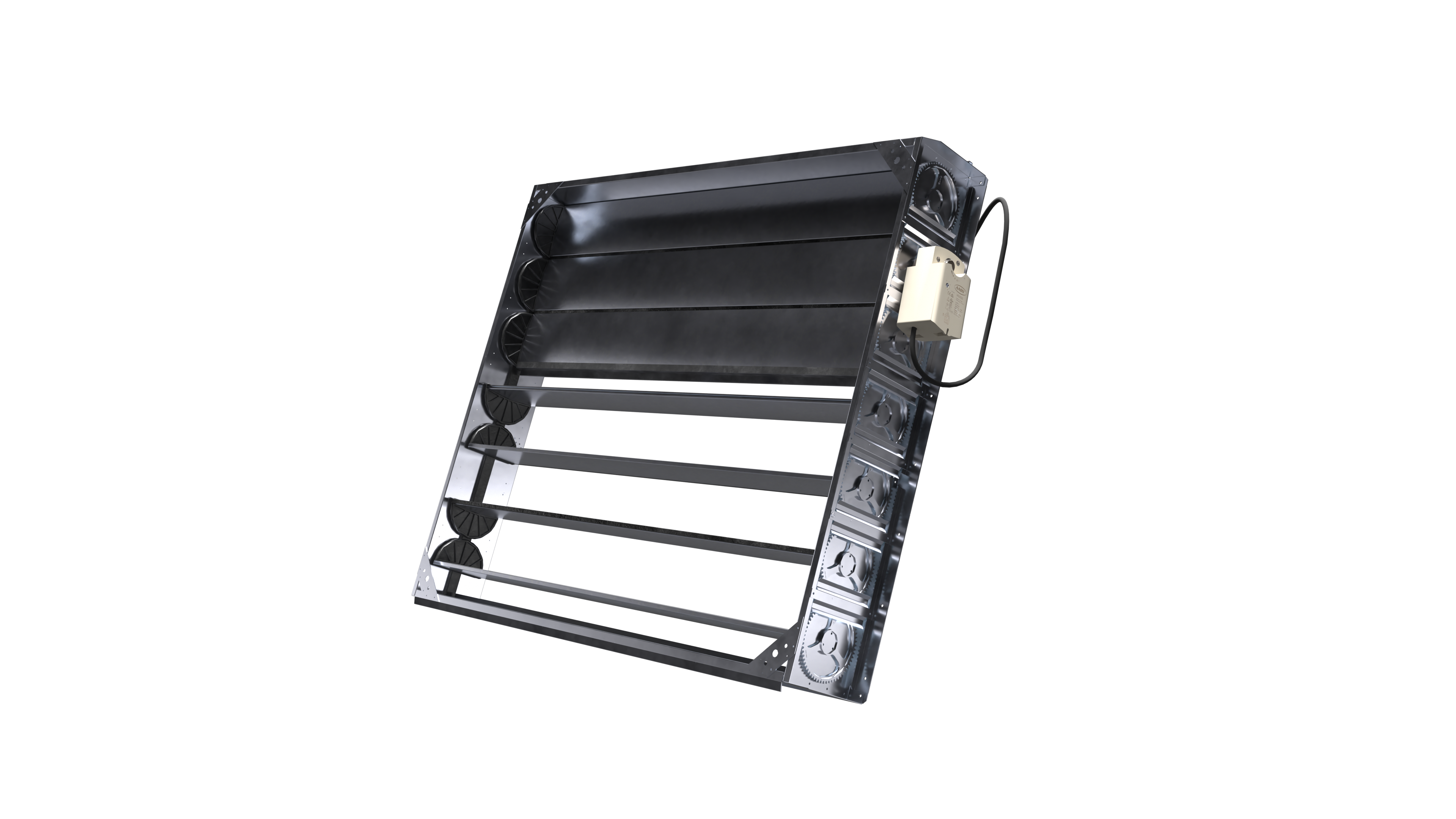
Economizer
Humidification and Dehumidification Systems
A cooling coil removes some moisture, but it is not always enough. Additional humidity control features are housed in the air handling unit.
Hot gas reheat is a common approach to dehumidification. The coil overcools the air to remove moisture, then a reheat coil brings the supply air back up to a comfortable temperature, using heat that would otherwise be rejected outdoors. Modulating hot gas reheat does the same thing with tighter control and without the temperature swings that come with on/off reheat.
Humidification goes the other direction. Steam or evaporative humidifiers can be installed in the air handler for spaces that require tight humidity control.
Energy Recovery
Air handling units can contain energy recovery devices too, whether that is an energy recovery wheel or a fixed plate exchanger. These sit between the exhaust and outdoor airstreams and move energy from one to the other, saving on cooling or heating demands. To learn more about these devices, click here.
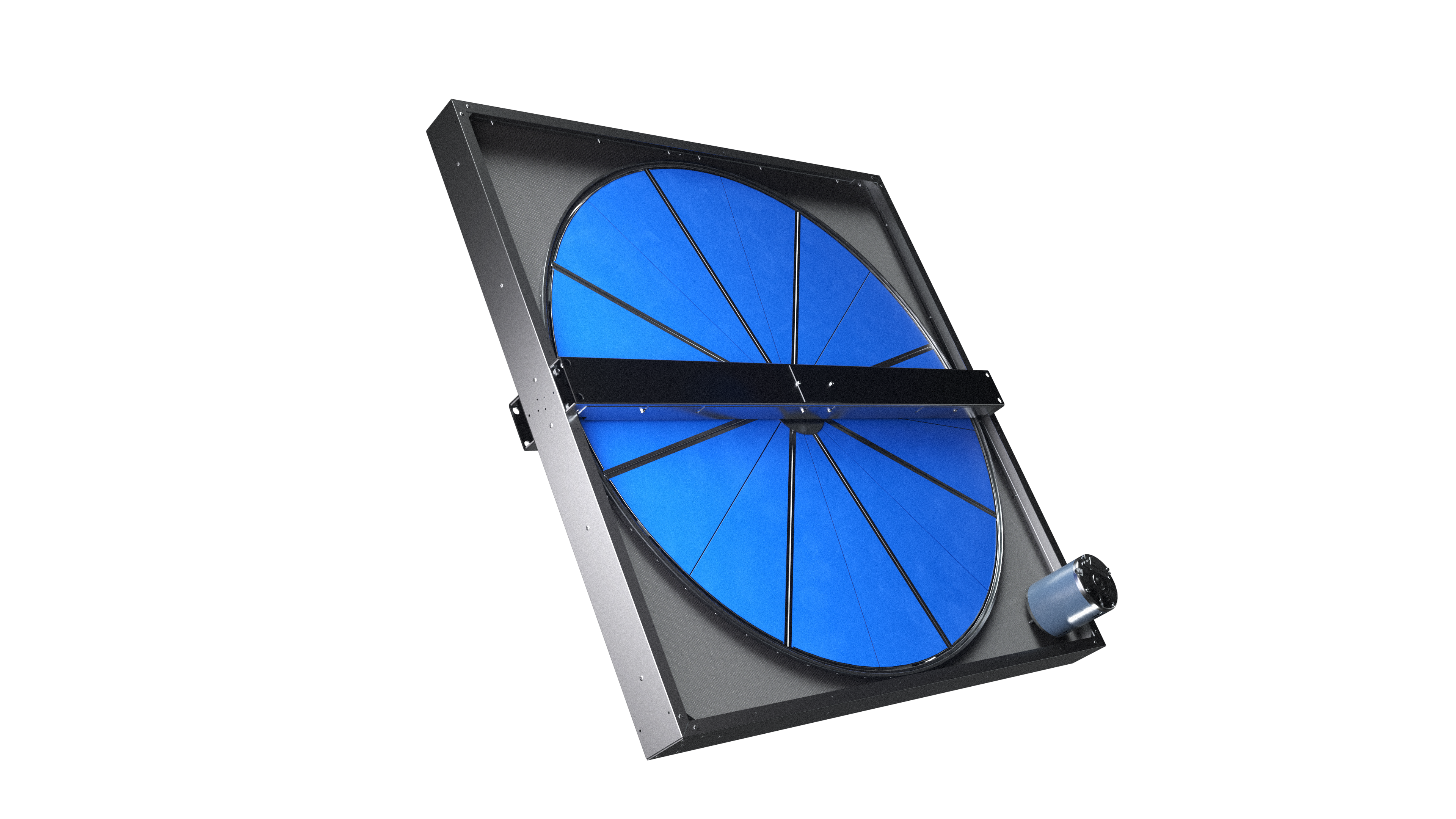
Energy Recovery Wheel
Sound Attenuators and Cabinet Insulation
Sound attenuators are lined sections installed in the supply or return airstream. Air passes through them, and the sound is absorbed resulting in quieter operation.
Cabinet construction can play large role in noise reduction as well, based on thickness and insulation type used. Double-wall panels with foam-injected insulation, such as those offered by AAON, help reduce unit-generated noise while providing superior thermal insulation compared to single wall fiberglass. They also offer greater durability and maintain their performance better over the life of the equipment. Quiet operation is important for both indoor units, sitting next to occupied spaces, and rooftop top units, sitting over a classroom or conference room.
Types of Air Handling Units — Which AHU Is Right for Your Building?
Indoor Air Handling Units
Indoor air handling units are installed inside the building. This could be in the basement, a mechanical room, a closet, etc. From there, they connect to a condensing unit outside, or to a chiller and boiler plant in the mechanical room.
Indoor units are available in both horizontal and vertical configurations to accommodate space requirements.
Outdoor Air Handling Units
Outdoor air handling units are typically found on the rooftop of a commercial building, often bringing in outdoor air. These units are designed for outdoor use, with standard weather resistant cabinets and corrosion protection.
Variable Air Volume (VAV) Air Handling Units
This is where you have a central AHU that modulates airflow to multiple VAV terminal boxes located in the ductwork. Each box controls airflow to its own zone, and the AHU fan modulates to hold duct static pressure as those boxes open and close. Every space with a box gets individual control.
Compare that to a constant volume unit, where airflow stays constant and the unit varies supply air temperature instead. VAV costs more up front and saves fan energy over the life of the system, which is why it is a popular choice for both medium and large commercial buildings.
Dedicated Outdoor Air Systems (DOAS) — The Modern IAQ Solution
DOAS units, or Dedicated Outdoor Air Systems, supply a space with 100% conditioned outdoor air. Their purpose is bringing fresh air into the space to meet IAQ requirements, while operating separately from the heating and cooling equipment serving the space.
Separating these functions provides several advantages. The DOAS is dedicated to handling the outdoor air load, including the latent load, which is the primary source of moisture entering the building. This allows the space-conditioning equipment to focus solely on the sensible load, enabling smaller unit sizes and more efficient operation. In addition, ventilation rates can be delivered and verified independently, improving overall system performance and control.
DOAS units can include energy recovery, which can increase cost savings by preconditioning the outdoor air. This device can make all the difference in a hot and humid climate.
How to Size an Air Handler Unit — CFM, Tonnage, and Load Calculations
Step 1 — Perform a Building Load Calculation
Sizing commercial air handling equipment begins with the heating and cooling load calculation. Inputs include building area, occupancy, envelope characteristics, climate zone, internal loads, and ventilation requirements.
Consult the ASHRAE Handbook or ACCA Manual N for an in-depth explanation of load calculations for commercial applications.
Step 2 — Determine Required Airflow
ASHRAE Standard 62.1 sets minimum outdoor air rates based on occupancy and the size of the space. Healthcare application requirements come from ASHRAE Standard 170 instead, which sets minimum air change rates. Knowing the airflow you need is what informs the size of the equipment you will need to design.
Step 3 — Match AHU to Outdoor Unit Capacity
If the air handling unit is part of a split system, it is important for it to match the outdoor unit capacity. Mismatched systems cause inefficiency and poor performance, along with other issues.
Oversized vs. Undersized Air Handlers — Real Consequences
Oversizing or undersizing equipment comes with real consequences. This is not true for just air handlers, but affects all HVAC equipment.
Oversizing can lead to the system short cycling, difficulty controlling humidity, and driving higher energy costs. When a unit satisfies the setpoint too quickly, it cannot adequately dehumidify the space, resulting in a cold, humid environment and excessive compressor cycling.
Undersized equipment leads to units running long or continuously, unable to meet setpoint on design days, which accelerates wear and tear and shortens equipment lifespan.
Air Handler Unit Applications by Industry
Healthcare and Hospital AHUs — Infection Control and IAQ
Healthcare holds the highest air handling standards. ASHRAE Standard 170 sets minimum outdoor air and total air change rates, filtration ratings, humidity ranges, and pressure relationships for each space type for the equipment to meet.
Data Center AHUs — Precision Cooling and Humidity Control
Data centers run tight temperature and humidity tolerances that require dedicated equipment. The load is predominantly sensible and remains relatively constant, with no occupancy-driven fluctuations and minimal moisture generation, the equipment's role is significantly different from that in an office building.
Air handlers in this application are generally selected for a high sensible heat ratio, for redundancy, and for airflow management that keeps supply and return air properly separated.
Education (K-12 and Higher Ed) — Demand-Controlled Ventilation
Fresh air is important for K-12 schools and higher education. These applications have specific ventilation requirements, and the air handling unit can be configured to provide the necessary outdoor air and filtration to support a healthy learning environment.
Natatoriums and Pool Rooms — Humidity and Corrosion Control
Natatoriums are one of the harder applications in commercial HVAC. The space runs high humidity around the clock from pool evaporation, and the air contains chloramines, which are corrosive to building materials and equipment alike. This requires a system that can control humidity, provide consistent airflow to remove contaminants, and survive corrosion.
Energy Efficiency in Commercial Air Handling Units
Air handling units can offer many features that promote energy efficiency in the design.
Variable Frequency Drives (VFDs) and ECM Motors
VFDs and ECM motors on fans allow them to modulate speed to the actual load required. Both reduce fan energy consumption at part load, which is where equipment spends the overwhelming majority of its operating hours.
Energy Recovery — Wheels, Plates
Energy recovery in AHUs recovers heat (sensible) or heat and moisture (enthalpy, or total) from the exhaust air and uses it to precondition incoming outdoor air. This reduces the cooling or heating loads, thus lowering mechanical cooling and heating usage, bringing down overall energy costs.
AAON's Commitment to Low-GWP Refrigerants (R-454B)
AAON has transitioned to R-454B, an A2L refrigerant with a GWP of 466. This is well below the EPA’s 700 GWP limit for new comfort cooling equipment under the Technology Transitions Rule and represents a significant reduction compared to R-410A.
AAON air handling units that are part of a DX cycle using refrigerant are designed for R-454B.
Air Handler Unit Maintenance — Keeping Your AHU at Peak Performance
With any HVAC equipment, maintenance is the key to a long lifespan.
Monthly Maintenance Tasks
A monthly inspection of supply fans, evaporator coils, and air filters can help identify potential issues before they become costly problems.
Quarterly Maintenance Tasks
Coil cleaning, refrigerant charge checks, inspection of belts on belt driven fans, controls calibration, and damper operation checks on a quarterly basis can help keep the unit running smoothly.
Annual Maintenance and Performance Assessment
A qualified service technician should perform a full assessment on the equipment at least once a year, at the bare minimum.
Common Air Handler Unit Problems
Common unit problems include:
- Clogged filters – Dirty filters can become clogged, which restricts airflow and raises static pressure.
- Frozen coils – A coil can freeze from low refrigerant charge, but low airflow can also cause this. Low airflow usually traces back to dirty filters or dirty coils, and once the coil ices over, airflow drops further.
- Faulty blower motors – Blower motors can be a common pain point in units, leading to unusual noises, uneven airflow, and inconsistent performance.
- Condensate drain clogs – Debris ranging from algae buildup to dirt or flakes of rust can clog condensate drains, which leads to water backing up into the unit and causing damage.
- Dirty coils – Coils that are not maintained become dirty, which reduces heat transfer and raises energy usage. On the cooling side, a dirty coil also reduces dehumidification.
Air Handler Unit Selection Guide — 7 Factors Specifying Engineers Must Evaluate
- Airflow Rate and Capacity (CFM) — Match the AHU to the calculated building load.
- Cooling Configuration — DX refrigerant coil vs. chilled water coil, tied to central plant availability.
- Heating Configuration — Electric heat strips, hot water coil, steam coil, gas heat, or heat pump.
- Indoor vs. Outdoor Installation — Building layout, mechanical room availability, and access for maintenance.
- Energy Recovery Requirements — Sensible vs. total energy recovery selection.
- Filtration Level — MERV rating required by application.
- Controls and BAS Integration — Identify the control systems that needs to be used, and ensure the equipment is compatible with it.
AAON Air Handling Units — Product Line Overview
Indoor Air Handling Units — H3 Series and V3 Series
AAON H3 and V3 air handlers are available as air handling units with chilled water or direct expansion (DX) coils. H3 is the horizontal configuration, while V3 is the vertical configuration.
Modular Indoor Air Handling Unit — M2 Series
AAON M2 products come in a modular configurable design, and are available as an air handling unit with chilled water or direct expansion coils.
Self-Contained Air Handling Units — SA and SB Series
The AAON SA and SB series are vertical self-contained units, both options are available as chilled water or non-compressorized DX indoor air handling units.
Rooftop Air Handling Units — RN, RQ, and RZ Series
AAON RN, RQ, and RZ products are available as packaged units configured as non-compressorized outdoor air handling units with chilled water or DX coils.
AAON ECat Selection Software — Spec the Right AHU for Your Project
AAON ECat selection software can be used to select and configure AHU models for project-specific requirements, including coil selections, fan performance, performance ratings, and configured options. To order AAON air handling units for your next project, contact your local AAON rep.
Frequently Asked Questions About Air Handler Units
What is an air handler unit (AHU)?
Per ASHRAE, an air handling unit is an assembly of sections built around one or more fans, along with the equipment needed to circulate, filter, heat, cool, humidify, dehumidify, mix, or recover energy from air, and the controls that operate it. Air handlers condition the air and distribute it to the space.
What is the difference between an air handler and an air conditioner?
Air conditioner refers to what cools the air, while the air handling unit is what conditions and distributes that air into the space.
Does an air handler unit need a furnace?
No. Commercial AHUs can be paired with boilers, use hot water or steam coils, use electric heat, or be part of a heat pump system that provides the heating. A furnace is just one option.
What is a DOAS air handler and why does it matter?
A Dedicated Outdoor Air System (DOAS) AHU conditions 100% outdoor air separately from space conditioning. It improves indoor air quality, reduces humidity loads on zone equipment, and makes compliance with ventilation requirements easier to demonstrate.
How long does a commercial air handler unit last?
With proper maintenance, a commercial AHU typically lasts 20 to 25 years. Equipment quality, operating conditions, maintenance frequency, and refrigerant transitions all influence longevity. AAON units are designed for durability and long service life.
What is a VAV (Variable Air Volume) air handler?
A VAV AHU supplies variable amounts of conditioned air to zones based on real-time demand. The central AHU fan modulates speed while VAV terminal boxes adjust airflow to each zone. VAV is a common system type in medium to large commercial buildings.
What is the difference between a chilled water and DX air handler?
A DX (direct expansion) AHU uses refrigerant-filled coils to cool air directly, typically paired with a condensing unit. A chilled water AHU uses water cooled by a central chiller plant, circulated through coils inside the AHU.
How do you size a commercial air handler unit?
Sizing requires a load calculation, determination of required CFM, outdoor air requirements per the applicable industry standard, and matching the AHU capacity to the outdoor unit if the equipment is part of a split system.
What refrigerant do AAON air handlers use?
AAON has transitioned to R-454B, an A2L refrigerant with a global warming potential of 466. R-454B replaces R-410A (GWP 2,088) and falls well under the 700 GWP limit the EPA set for new comfort cooling equipment, supporting decarbonization goals and future-proofing building HVAC investments.