![AAON knowledge base logo 2023.png]](https://www.aaon.com/hs-fs/hubfs/AAON%20knowledge%20base%20logo%202023.png?height=40&name=AAON%20knowledge%20base%20logo%202023.png)
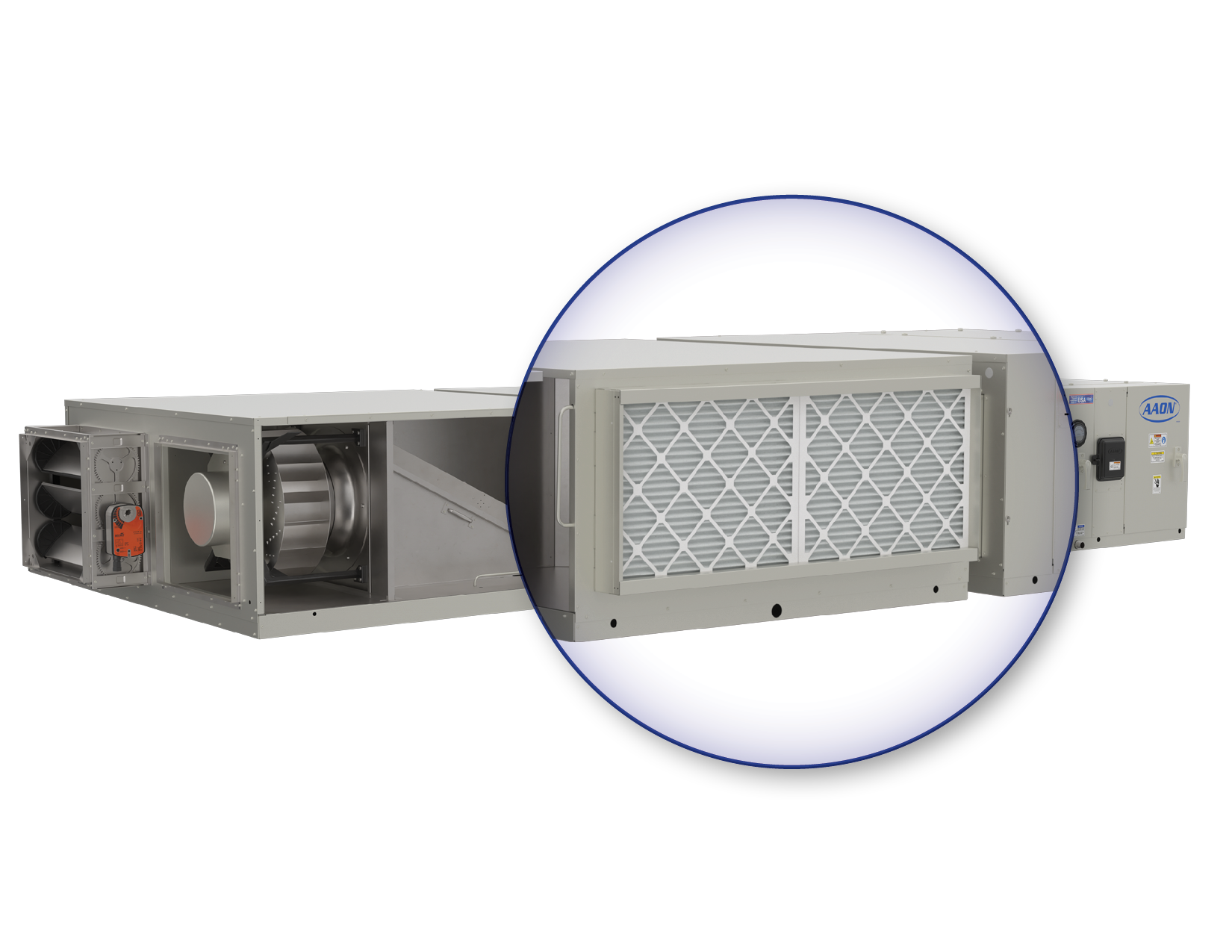
AAON H3 Series Filter Section
What Is a MERV Rating? (And Why It Matters for Your Equipment)
MERV is the Minimum Efficiency Reporting Value. It measures how effective a filter is at capturing different airborne particles.
A higher MERV means higher filtration and capture of smaller particles - which, in turn, means more airflow resistance for your equipment to push through.
The MERV Scale Explained: From 1 to 16
The MERV scale defined by ASHRAE Standard 52.2 runs from 1 to 16.
MERV 1–4 (10 – 30+ µm): This is the lowest filtration. These are often used as pre-filtration in residential equipment or used as the filters found in window AC units. These filters also come as a fiberglass or metal mesh filters, typically used to filter the outside air of commercial HVAC equipment. They capture only the largest particles, like pollen, large dust particles, and lint, and offer minimal airflow restriction.
MERV 5–8 (3 – 10 µm): These filters sit in the middle of the scale and capture medium-sized particles like pollen, fine dust particles, and larger mold spores. They are the minimum standard for residential HVAC and are the most common filters found in homes, and in commercial applications like offices. These are often the cheap disposable filters needed for moderate filtration.
MERV 9–12 (1 – 3 µm): These offer better filtration, capturing smaller particles like lead dust, auto emissions, smoke, and pet dander. They are often the standard for commercial HVAC equipment in schools and offices, and in more modern residential dwellings. In order to handle the extra airflow restriction, these filters require systems with a strong blower.
MERV 13–16 (0.3 – 1 µm): These efficient filters are often the highest ones offered for most HVAC systems. They capture particles like bacteria, sneeze droplets, and virus-carrying particles. These filters are found in applications like general surgery suites and smoking lounges. Systems with these filters require a design that adapts to the high airflow restriction.
HEPA Filters: These are the highest-rated filters, designed to capture viruses, radioactive particles, ultra-fine dust, and particles. These are the filters are commonly used for cleanrooms, pharmaceutical manufacturing, and specialized surgery rooms. They have extreme airflow restriction and are found in systems designed with features to support them. Often times, certain applications will require these filters based on code regulations.
How MERV Ratings Are Tested (ASHRAE Standard 52.2)
The MERV rating system is defined by ASHRAE, with the ratings based on the test procedure in ASHRAE Standard 52.2.
The ratings are measured by the filter’s minimum efficiency achieved in testing – not its average. This means the filter has demonstrated performance at or above its assigned rating, and will often exceed that rating under normal operating conditions.
MERV 8 vs MERV 11 — Head-to-Head Comparison
When purchasing a filter, there is no single right answer. It's best to compare and consider which option is best for you - in pricing, in performance, and in the air quality you need.
MERV 8 filter is often enough to address the air quality concerns for an average indoor space. If your space requires more filtration, MERV 11 filters are a good option for efficiency without overworking your system. The table below shows some comparisons between the two levels of filtration and a summary of what they are typically used to filter.
|
|
MERV 8 |
MERV 11 |
|
Particle Size / Efficiency |
Captures particles in the 3.0–10 μm range at roughly 70–85% efficiency. |
Captures 3.0–10 μm particles at 85%+ efficiency and 1.0–3.0 μm particles at 65%+. It also captures the finest 0.3–1.0 μm particles at about 20%+ efficiency. |
|
What is captured? |
Dust, lint, pollen, and larger mold spores. |
Catches everything MERV 8 captures, plus fine dust, pet dander, some bacteria, smoke particles, and finer mold spores. |
|
Typical Commercial Application |
Offices and retail. Can also be used as the pre-filter ahead of high-efficiency filters. |
Offices and retail that want better indoor air quality than MERV 8 provides, schools with systems that cannot handle a higher MERV filter, high-occupancy buildings, or buildings in areas of higher pollution. |
|
Typical Residential Application |
Standard filter for most homes. |
Homes with pets or allergy concerns, or homes located in industrial areas. |
|
Airflow Resistance |
Low restriction and easy on the fan motor. Lowest pressure drop, and easy on the budget across multiple units in a commercial application. |
Higher restriction than MERV 8, adding more strain, particularly in residential units. Because of the higher pressure drop, it could lower system efficiency and reduce airflow. |
|
Costs |
Costs will vary by filter thickness and bulk pricing. Expect the MERV 11 to cost more per filter - roughly $3 to $4 more. |
|
For most residential and commercial applications like offices and retail, a MERV 8 filter meets the baseline minimum set by ASHRAE Standard 62.1.
For commercial applications, various ASHRAE standards (such as 62.1 for general ventilation and 170 for healthcare) set minimum MERV recommendations by application or use case, so filter selection should always take the applicable standard and system design into account.
The Key Difference — Media Density and Pleat Geometry
So how do these filters achieve different MERV ratings?
It’s all in the design of the filter.
MERV 11 filters achieve that increase in filtration with a tighter fiber weave, along with more pleats. The extra pleats create greater surface area, which lets air pass through more easily while also giving particles more chances to get trapped in the filter.
Another design element some MERV 11 filters offer is specialized synthetic fibers that carry a static charge. This means that even if a particle is small enough to fit through the gaps in the media, the static charge forces it to stick to the fibers.
It's important to factor in ASHRAE guidance points for MERV-A ratings (like MERV 11A) for applications with systems that cannot handle MERV 13. The MERV-A designation is for filters that have been tested after their electrostatic charge has been emitted, confirming that the fibers and pleats can maintain a MERV 11 rating on their own, without relying on the charge.
MERV 8 vs MERV 11 — Airflow, Pressure Drop, and HVAC System Performance
How Pressure Drop Affects Your HVAC Equipment
A higher MERV filter means a higher pressure drop, which requires the blower motor to work harder to maintain the necessary airflow. With single-speed motors, this can cause issues like reduced airflow, increased run times, an overheating heat exchanger, or a shortened blower life. However, most modern systems utilize variable-speed motors, like VFD or ECM driven, which adjust to maintain the required airflow. While they do require more power, variable-speed motors maintain consistent airflow even when the pressure drops and rises.
While a MERV 11 filter creates more static pressure than a MERV 8 filter, the increase is usually minimal and unlikely to affect the performance of most modern systems. When you apply high-efficiency filters, it's paramount that your system is capable of handling the additional static pressure and maintaining the required airflow. Before upgrading your system’s filters, you should determine the fan curve to ensure the system maintains a safe operating limit.
When High MERV Filters Can Strain an HVAC System
Using a higher MERV filter than your system is designed to accommodate can lead to operational issues.
You may notice weaker airflow, rooms struggling to reach temperature, longer run cycles, whistling sounds from the return vents, or even the filter visibly bowing in. If you notice these signs, this means your system’s performance isn't capable of balancing the increased pressure, or a possible clogged filter that needs replacing. A dirty filter can cause more airflow restriction than a clean, higher-MERV-rated filter.
How Modern HVAC Systems Are Designed for Higher-Efficiency Filtration
Most modern commercial HVAC systems are designed around the customer selected MERV filter rating. This ensures the system is matched to the specific airflow and static pressure parameters of that filter. This does not limit future filter upgrades, though an equipment specification consultation is recommended to verify performance compatibility before upgrading.
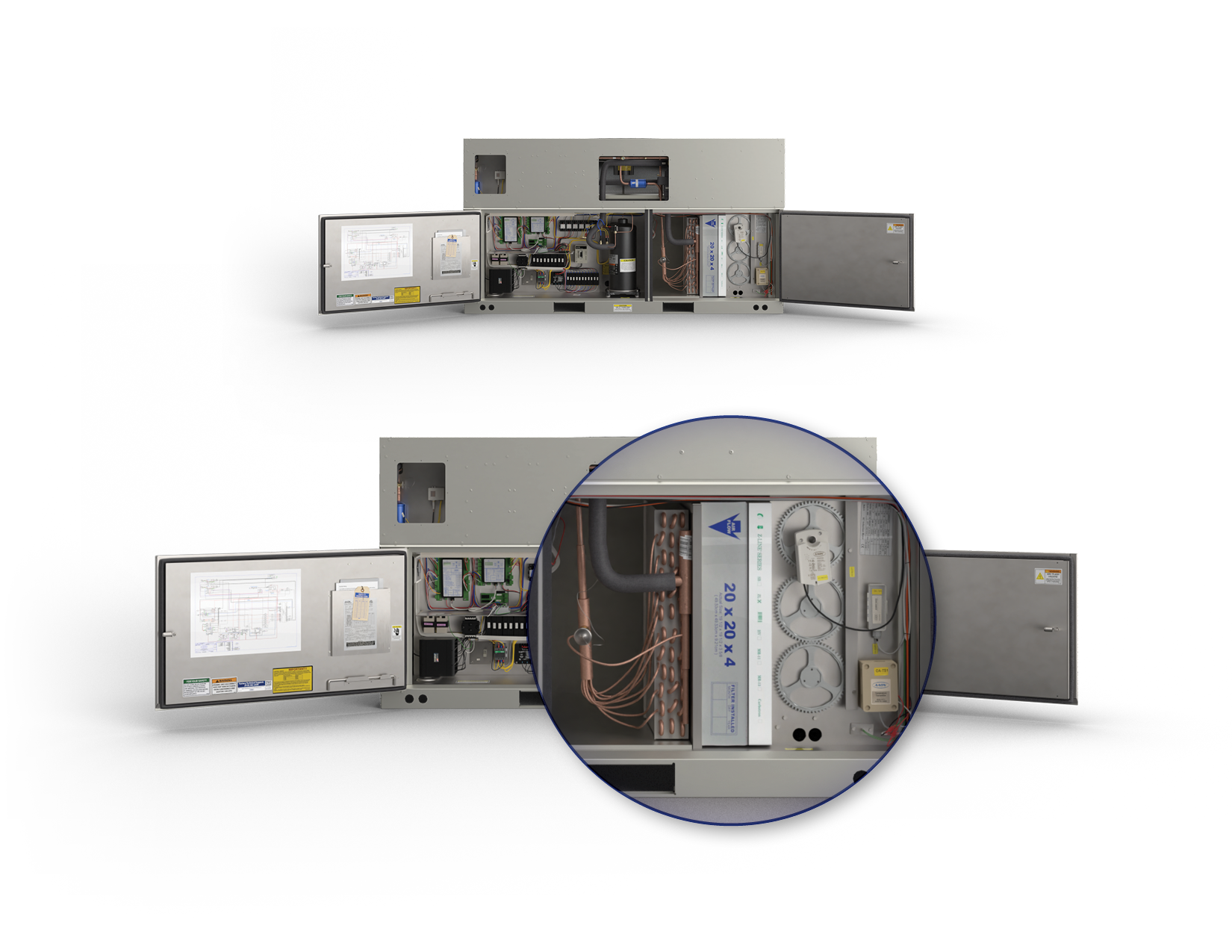
RQ Series with Pre-Filters
Who Should Choose MERV 8 — and Who Should Choose MERV 11?
MERV ratings should be selected based on the application’s needs or requirements. Most light commercial applications, like offices, retail, and residential homes, are fine with lower-rated MERV filters. For applications where indoor air quality becomes more of a concern, like a high-occupancy school or a home with an allergy-sensitive occupant, a higher MERV rating may be required.
MERV 8 Is the Right Choice If…
- Standard residential homes without allergies or pets
- Older HVAC systems with limited airflow
- Commercial applications where basic filtration is fine
- Environments where filter replacement schedules are inconsistent (lower-rated MERV filters clog slower)
MERV 8 does not mean a low-quality filter; it’s often the baseline for filtration.
MERV 11 Is the Right Choice If…
- Residential homes with pets or allergy or asthma sensitive occupants
- Urban environments with pollution
- Commercial applications, like schools, with older systems that cannot handle MERV 13
MERV 8 vs MERV 11 — Cost, Replacement Frequency, and Long-Term Value
Upfront Filter Cost Comparison
Costs will vary by filter thickness and bulk pricing. Expect the MERV 11 to cost more per filter than a MERV 8 (roughly $3 to $4 more). That difference could be negligible for a single filter replacement. However, in commercial applications with multiple filters, the cost impact can be more noticeable.
How Often Should You Replace MERV 8 vs MERV 11 Filters?
Replacement frequency will vary based on application, filter type, number of filters, and filter thickness.
For commercial applications, facility managers often have their own maintenance schedule that includes filter inspections. These are usually scheduled around ASHRAE standard recommendations, a manufacturer’s pressure-drop threshold, application, and other, similar factors. Many modern commercial systems also incorporate sensors that alert facility managers when a filter requires replacement. Typically, unit inspections are done every month or quarter, depending on the facility.
For an average home with a standard 1-inch filter, a filter inspection every 60–90 days is generally recommended. MERV 11 filters should be checked more often, since they clog faster.
Energy Cost Impact — Does MERV 11 Raise Your Utility Bill?
The difference in energy costs between MERV 8 and MERV 11 is usually minimal. The biggest energy cost from a filter usually comes from a clogged or dirty filter, which restricts more airflow than a clean MERV 11 filter.
MERV 8 vs MERV 11 for Allergies, Pets, and Indoor Air Quality
MERV rating recommendations will vary based on the indoor air quality the application needs to achieve. MERV 11 is often the recommended minimum for households with occupants that suffer with allergies or asthma, with higher MERV ratings often preferred in newer systems. For capturing pet dander in households with animals, a MERV 11 or above is recommended.
If the system can support it, a MERV 13 offers greater protection, and is recommended by the EPA for residential homes if properly supported by the system.
MERV 11 and Wildfire Smoke — What You Need to Know
MERV 11 filters can capture some smoke particles, but they are not recommended for areas where wildfires are a common occurrence.
The EPA recommends at least a MERV 13 filter rating during smoky periods, as higher-MERV-rated filters are more effective at removing the pollution in smoke. It is also worth the consideration to invest in a HEPA air purifier for such circumstances. The table below compares all three of the most common MERV ratings.
MERV 8 vs MERV 11 vs MERV 13 — Where Does Your Need Fall?
|
|
MERV 8 |
MERV 11 |
MERV 13 |
|
Particle Size / Efficiency |
Captures particles in the 3.0–10 μm range at roughly 70–85% efficiency. |
Captures 3.0–10 μm particles at 85%+ efficiency and 1.0–3.0 μm particles at 65%+. It also captures the finest 0.3–1.0 μm particles at about 20%+ efficiency. |
Captures 3.0–10 μm particles at 90%+ efficiency and 1.0–3.0 μm particles at 85%+ efficiency. It also captures 0.3–1.0 μm particles at 50%+ efficiency - the highest efficiency in this comparison table for the smallest particle range. |
|
What is captured? |
Dust, lint, pollen, and larger mold spores. |
Catches everything MERV 8 captures, plus fine dust, pet dander, some bacteria, smoke particles, and finer mold spores. |
Captures everything a MERV 11 filter will capture, plus most bacteria and most smoke and wildfire pollutants. This includes particles in the size range associated with respiratory droplets. |
|
Typical Commercial Application |
Offices and retail. Can also be used as the pre-filter ahead of high-efficiency filters. |
Offices and retail that want better indoor air quality, schools with systems that cannot handle a higher MERV, high-occupancy buildings, or buildings in areas of higher pollution. |
General hospital areas (not surgical areas), schools with upgraded HVAC, and buildings with concerns about urban pollution or wildfire smoke. |
|
Typical Residential Application |
Standard filter for most homes. |
Homes with pets or allergy concerns, or homes located in industrial areas. |
Recommended for HVAC systems that can handle it, as the minimum MERV rating for asthma or significant allergy concerns. Also recommended for homes in areas with wildfire-smoke concerns. |
|
Airflow Resistance |
Low restriction and easy on the fan motor. Lowest pressure drop, and easy on the budget across multiple units in a commercial application. |
Higher restriction than MERV 8, adding more strain, particularly in residential units. Because of the higher pressure drop, it could lower system efficiency and reduce airflow. |
Highest pressure drop and restriction of the three filters. Not as simple a switch as going from MERV 8 to MERV 11. MERV 13 filters can reduce airflow significantly in older systems, straining the equipment. They require a system that is rated for them. |
|
Costs |
Costs will vary by filter thickness and bulk pricing. |
Expect the MERV 11 to cost more per filter - roughly $3 to $4 more than a MERV 8. |
Most expensive of the three choices - several dollars more than a MERV 11. |
When to Consider Upgrading to MERV 13
MERV 13 filters are generally recommended for systems that can properly support a MERV 13 filter – especially for households with heavy smokers, asthmatic occupants, or polluted areas. It should be noted that, for commercial applications, you should consult the latest ASHRAE standards or local codes to ensure indoor air quality requirements are met.
How to Choose the Right MERV Filter for Your HVAC System — Step-by-Step
Step 1 — Check Your HVAC System's Maximum Rated MERV
If you’re looking to upgrade your system’s filters, the first step should be to consult the equipment manual and find out the maximum MERV rating of your equipment.
Step 2 — Assess Your Household's Air Quality Needs
If residential: Are there pets? Do any occupants have allergies or asthma? Do you live near a busy road or in a wildfire-prone region?
If commercial: What indoor air quality standards/specifications does your application require? Are there code compliance requirements for air treatment?
Step 3 — Evaluate Your System's Age and Blower Type
Systems with variable-speed blowers can easily accommodate an upgrade to a higher MERV-rated filter. Older systems with single-speed blowers may not be able to handle the increase in pressure drop.
If unsure consult an experienced HVAC technician.
Step 4 — Set a Filter Replacement Schedule and Stick to It
A clogged filter is the biggest risk to operation, regardless of MERV rating. Set up a filter replacement schedule and stick to it. AAON offers features such as a clogged filter switch and magnehelic gauge to check the pressure drop across the filters, which can be used to determine if filters need to be changed.
For commercial applications, you should have a maintenance schedule for inspections and replacements.
Frequently Asked Questions About MERV 8 vs MERV 11
What is the difference between MERV 8 and MERV 11 filters?
MERV 8 captures particles in the 3–10 micron range (dust, pollen, lint) at 70%+ efficiency. MERV 11 captures particles down to 1 micron (fine pet dander, larger mold spores, some bacteria), at 65%+ efficiency in the 1–3 micron range and 85%+ in the 3–10 micron range.
Is MERV 11 too high for a residential HVAC system?
It depends on your system. Most modern residential systems are designed to operate safely and properly with MERV 11 filters. Issues occur in older systems with single-speed blowers or undersized ductwork that cannot handle the pressure drop. Check the system’s manual or consult an HVAC technician for the recommended MERV ratings for your system.
Will upgrading from MERV 8 to MERV 11 increase my energy bill?
In a well-maintained system with regular filter replacements, the impact on energy costs is generally minimal. The larger energy penalty comes from a clogged filter restricting airflow or systems running near their airflow limits may see a small efficiency reduction. If you’re ever concerned about your system’s performance, consult an HVAC professional.
Which MERV rating is better for allergies?
MERV 11 is the better choice for mild allergy and asthmatic occupants (if the system is unable to handle a MERV 13 filter). It captures the fine pet dander proteins, pollen fragments, and mold spores that pass through MERV 8 filters.
How often should I replace a MERV 8 vs MERV 11 filter?
Both should be replaced every 60–90 days under typical residential conditions. Homes with pets, allergies, or high dust loads should replace filters every 30–60 days. MERV 11 may clog faster due to its higher particle capture rate. It’s a good idea to visually inspect your filters monthly.
For commercial applications, the facility manager will often determine the maintenance schedule, since it varies by application, filter type, and unit design.
What MERV rating do commercial buildings use?
General commercial buildings (offices, retail) typically use MERV 8 as the minimum standard for equipment protection and basic indoor air quality.
High-occupancy commercial buildings (schools, gyms, healthcare facilities) typically specify MERV 11 (or a MERV-A 11 rating per ASHRAE, if MERV 13 is not an option).
Critical environments (hospitals, cleanrooms) require higher efficiencies. These will require MERV 14 up to HEPA filters.
ASHRAE 62.1 governs ventilation and filtration standards for commercial applications.
Is MERV 8 good enough for a home without pets or allergies?
Yes. MERV 8 is often the recommended baseline for standard residential use. It effectively captures the particles responsible for most visible dust accumulation and seasonal pollen exposure. If no occupants have respiratory sensitivities and there are no indoor pets, MERV 8 offers reliable protection at a lower cost and with less airflow restriction.
Can I switch from MERV 8 to MERV 11 without modifying my HVAC system?
In most cases, yes - provided the system can handle the change in pressure (most modern ones can) and has no existing airflow issues. The pressure-drop increase from MERV 8 to MERV 11 is modest and within the tolerance of most systems. Consult an HVAC technician if you have any concerns.
AAON units can be customized to provide whatever level of filtration your application needs. Contact your local AAON rep today.
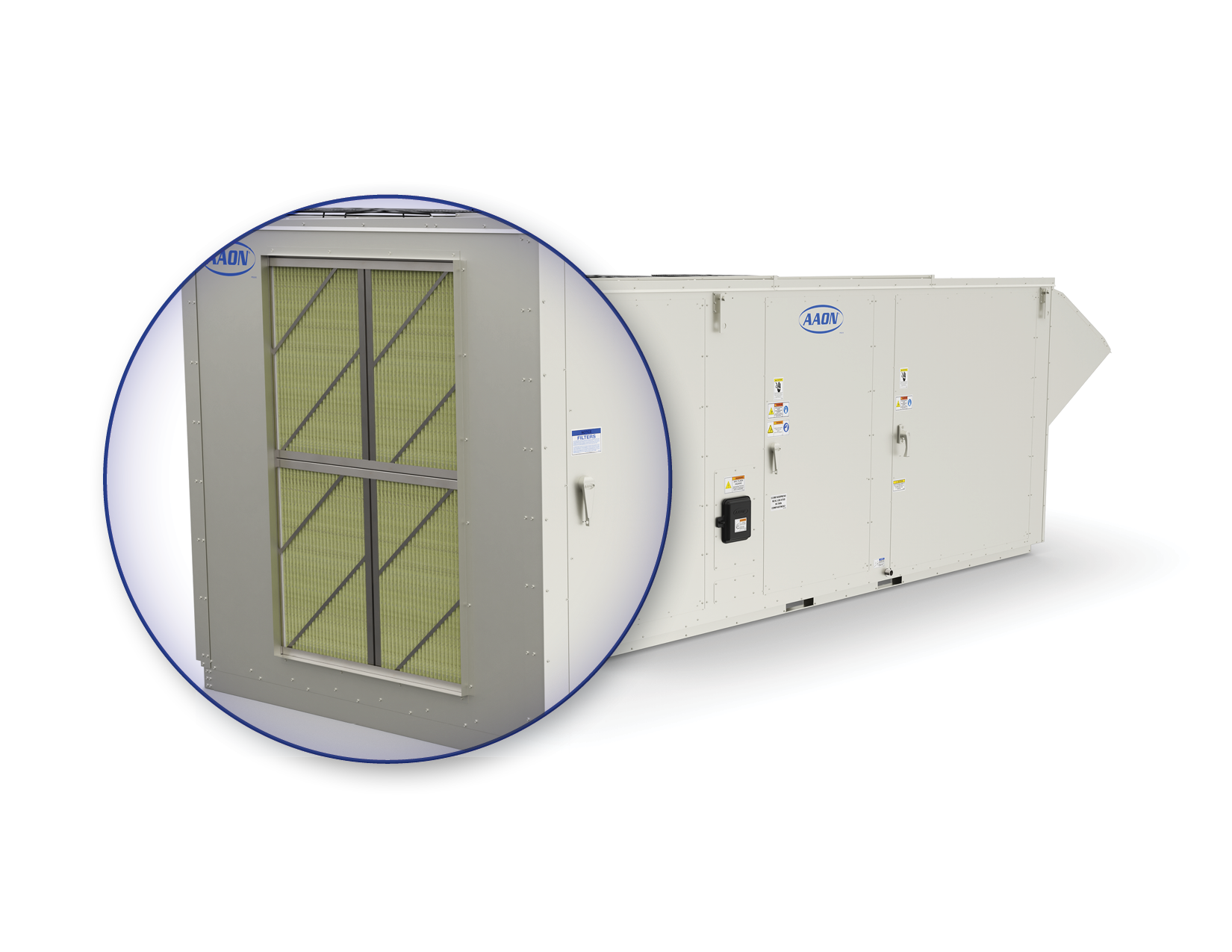
RN Series Horizontal Configuration with Final Filters