![AAON knowledge base logo 2023.png]](https://www.aaon.com/hs-fs/hubfs/AAON%20knowledge%20base%20logo%202023.png?height=40&name=AAON%20knowledge%20base%20logo%202023.png)
Primary sources: ASHRAE 15-2022, ASHRAE 34-‑2022, UL 60335‑-2-‑40 (Ed. 4), EPA AIM Act rules, Montreal Protocol & Kigali Amendment.
In 2025, the HVAC industry transitioned from refrigerants like R-410A to those with lower GWP (Global Warming Potential), under the EPA Technology Transition Rule. This rule requires refrigerants to have GWP limits of 700 and below in a phased approach for various sectors beginning in 2025.
Refrigerants that meet these new regulations, and other requirements, are classified as A2L under ASHRAE 34. Unlike R-410A and other A1 refrigerants, A2Ls (like R-32 and R-454B) are mildly flammable, so additional safety considerations provided by standards like UL 60335-2-40 and ASHRAE 15 must be adhered to.
Background: Why A2L Refrigerants?
- Montreal Protocol – signed in 1987, sought to protect the ozone layer by phasing out substances with high Ozone Depleting Potential, originally targeting hydrochlorofluorocarbons (HCFCs like R22). This led to the US‑ transitioning to R-410A, a hydrofluorocarbon (HFC) in 2010.
- Kigali Amendment (2016) - an amendment to the Montreal Protocol. It was adopted to reduce the prevalence of high GWP substances, adding a global HFC phasedown.
- A2L alternatives (like R-454B) have a lower GWP vs. legacy HFCs, aligning with the Montreal Protocol and subsequent Kigali amendment. A2L refrigerants also meet the current US EPA Technology Transition rule of the‑ GWP being limited to 700 and lower.
Refrigerant Charge Limits
Refrigerant charge limits help mitigate risks of toxicity, oxygen displacement, and flammability if leaks occur. ASHRAE 15 sets what these charge limits are, utilizing the refrigerant properties defined in ASHRAE 34 while considering the type of unit and occupancy classification of the space.
Before the transition to A2L refrigerants, charge limits in comfort cooling applications were rarely considered beyond applications like machinery rooms housing numerous large appliances. This was in part because historically refrigerants used were classified as A1. A1 refrigerants are defined as low-toxicity and non-flammable. With the transition to A2L refrigerants, which are classified as low toxicity but with mild flammability, it requires refrigerant charge limits to be taken into consideration for more applications.
It should be noted that A2L refrigerants when tested in accordance with ASTM E3681 demonstrated a flame propagation slightly above the classification of A1 or B1 but have a burning velocity that is slower than A2 or B2 classified refrigerants. So, yes, while A2L refrigerants are flammable, they do not pose the same risks as more explosive refrigerants like propane.
ASHRAE 34 provides the Refrigerant Concentration Limit (RCL) for substances that are covered under the standard. RCL provides the maximum concentration of a refrigerant, above which exposure can present a safety hazard. The RCL value is calculated as the lowest value among three critical safety values:
- Acute Toxicity Exposure Limit – this value is the maximum level of concentration allowed, above which dangerous bodily effects may occur from short-term exposure.
- Oxygen Deprivation Limit – this value is the concentration of refrigerant in the space that would cause oxygen to be displaced to unsafe levels.
- Flammable Concentration Limit – this is set at 25% of the Lower Flammability Limit (LFL). LFL is the minimum concentration of a refrigerant that supports combustion. FCL is designed to prevent the risk of ignition.
Key references:
- ASHRAE 34-2‑022 → safety classification, LFL, RCL definitions and data.
- ASHRAE 15-‑2022 → application safety and charge/volume compliance paths
- UL 60335-2‑-40, 4th Ed‑ → product safety standard, mitigation features (detectors, airflow), installation constraints noted on equipment.
A2L - Specific Charge Requirements
The use of A2L refrigerants necessitated the adoption of a new product safety standard. The previous standard, UL 1995, did not have considerations for flammable refrigerants. The industry decided to adopt IEC 60335-2-40 with national deviations as UL 60335-2-40, which had requirements specific to flammable refrigerants. UL 60335-2-40 requires charge limits and minimum room sizes to be considered and stated by the equipment manufacturer.
- Units with less than 62.6 oz of R-454B, no room restrictions are applied.
- Units with a charge of between 62.6 and 543 oz of R-454B, room size restrictions are required.
- Units with a charge greater than 543 oz require additional mitigation beyond just room size restrictions.
Calculations and tables that give charge limits and room size restrictions are provided in UL 60335-2-40 and ASHRAE 15.
Connected Adjacent Spaces
UL 60335-2-40 and ASHRAE 15 require each individual space served by a unit to be compliant with charge limitations. However, for the types of units that commercial HVAC manufacturers like AAON produce, these standards also provide means to include connected adjacent spaces in the total room size determination.
Multiple rooms can be treated as one continuous space if:
- Rooms are on the same floor and openings between two connected spaces are permanent.
- The openings must meet the required free area opening (see example below).
- At least 50% of the required ventilation opening area is below 200 mm.
- The individual room in which the unit is installed, or may leak into, may not be less than 20% of the minimum required floor area.
Note: For spaces on multiple floor levels that are open to each other, the lowest level of the space or connected spaces must meet the requirements for the minimum floor area.
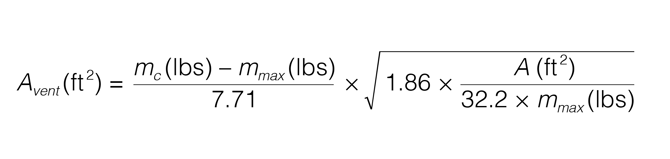
From equation 7-2a of ASHRAE 15, substituted for R-454B properties
Where:
mc is the refrigerant charge of the largest independent circuit
mmax is the maximum charge for the room served (from Equation GG.3DV of UL 60335-2-40 4th Ed)
A is the area of the space to be served
Consider the example depicted in Figure 1 below. This example consists of a room with a large envelope load and an adjacent room with no air distribution from this unit. This space is served by an RN-008 heat pump with reheat that is charged with 40 lbs of R-454B. The lowest opening in the connected ductwork is at 8 ft. Equation GG.4DV of UL 60335-2-40 requires a unit with this amount of charge to serve a space of just over 2000 square ft.
Room 1 is not large enough for the charge of this unit, but the combined area of Room 1 and Room 2 is large enough to dilute the full charge of the unit if a leak were to occur. If the above requirements are met, then the entire floor area of Room 1 and Room 2 may be considered one space. The required ventilation opening can be found by;
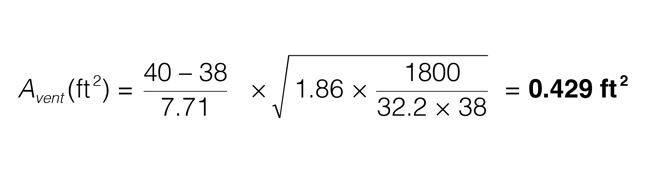
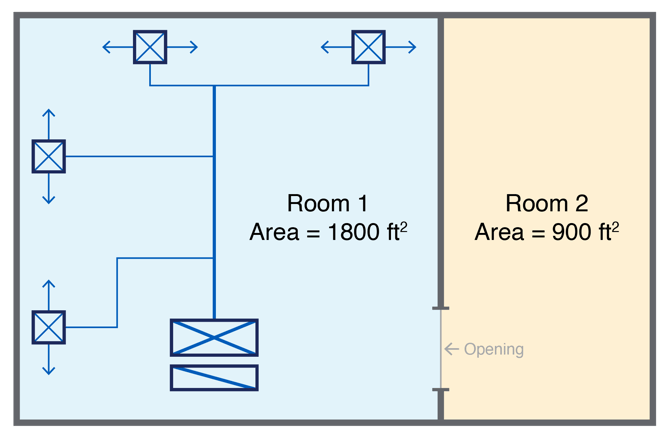 Figure 1
Alternatively, this same space could be served by an RN-009 consisting of two individual refrigeration circuits. Because both UL 60335-2-40 and ASHRAE 15 only consider a leak of concern of an individual circuit as likely to occur, only the largest circuit must be considered when determining charge limitations. When evaluated using an RN-009 with a largest circuit charge of 31 pounds, the minimum floor area required is only 1203 square ft.
UL 60335-2-40 provides product safety requirements to cover all allowable installations, while ASHRAE 15 provides safety requirements for the final installation. Some requirements in ASHRAE 15 may allow for less strict evaluation, since the final system layout may show areas where leaked refrigerant is unlikely to accumulate within some areas of the space served.
Note: Individual jurisdictions requirements may vary. Always verify correct installation requirements with the AHJ.
Additional Mitigation: Circulation Airflow
Both UL 60335-2‑-‑40 and ASHRAE 15 allow for circulation airflow to be provided by the unit to assist with diluting any leaked A2L refrigerant. This airflow prevents concentrations exceeding the LFL, both within the unit and in the space served by the unit. When this mitigation method is provided, the minimum floor area required can be decreased and the maximum for a given space can be increased.
Refrigerant detection systems may also be used in HVAC units utilizing A2L refrigerants. AAON uses refrigerant sensors to detect leaked refrigerant that could enter the space. These sensors will enable the unit blower to provide the required circulation airflow needed for dilution.
Both standards require a minimum amount of airflow to be provided, based on the amount of charge of the largest independent circuit, and the LFL of the refrigerant being used.
When Circulation Airflow Isn’t Preferred
While circulation airflow is often the best option for many applications, there are some applications that may have difficulty meeting the required minimum airflow.
The move toward electrification and heat pumps, combined with increasing efficiency requirements, often results in higher refrigerant charge totals compared to previous cooling-only units. Higher refrigerant charges translate directly to larger floor area requirements and higher minimum circulation airflow thresholds, which can make compliance more challenging in certain system configurations.
Energy codes that reduce the required minimum turndown for multizone VAV systems to 15% could result in the minimum airflow required for energy code compliance being less than what is needed for A2L leak mitigation.
Make-up air or DOAS applications can also be challenging when space pressurization, moisture removal, or the introduction of unconditioned outside air is a concern. In these applications, it may not be necessary to utilize circulation airflow if connected adjacent spaces are considered and planned for.
Self-contained‑ Indoor Equipment & Machinery Rooms
Self-contained indoor units have additional installation requirements.
If an indoor unit exceeds charge limits, ASHRAE 15 requires equipment to be located in a machinery room.
Note: Exception to this requirement for commercial occupancy is a charge limit of up to 22 pounds, and provided the equipment is not located in a public hallway or lobby.
Construction requirements for machinery rooms include things like:
- Tight fitting doors that open outwards.
- Appropriate clearances for electrical safety.
- Proper servicing clearances and egress.
- No openings or air transfers between the machinery room and occupied space that could allow for the escape of leaked refrigerant.
- Access to the machinery room restricted to authorized personnel only.
And when A2L refrigerants are present, additional requirements include:
- Doors must be self-closing fire doors.
- Fire rated construction of walls, ceilings, and floors.
- Air and surface temperature limits, among other additional requirements.
Where refrigerants other than A1 are present, machinery rooms are either Class I, Division 2 hazardous electrical locations under NFPA 70 or these rooms must provide continuous or refrigerant detected triggered ventilation in addition to other safety measures initiated‑ by detection of refrigerant that exceeds 25% LFL.
Note: The refrigerant detection system required for machinery rooms is separate from the refrigerant detection system installed in listed equipment as required for compliance with the product safety standard.
Where to Find Refrigerant Properties
ASHRAE Standard 34 is the industry-recognized standard for common refrigerant identification, safety classifications, and refrigerant concentration limits.